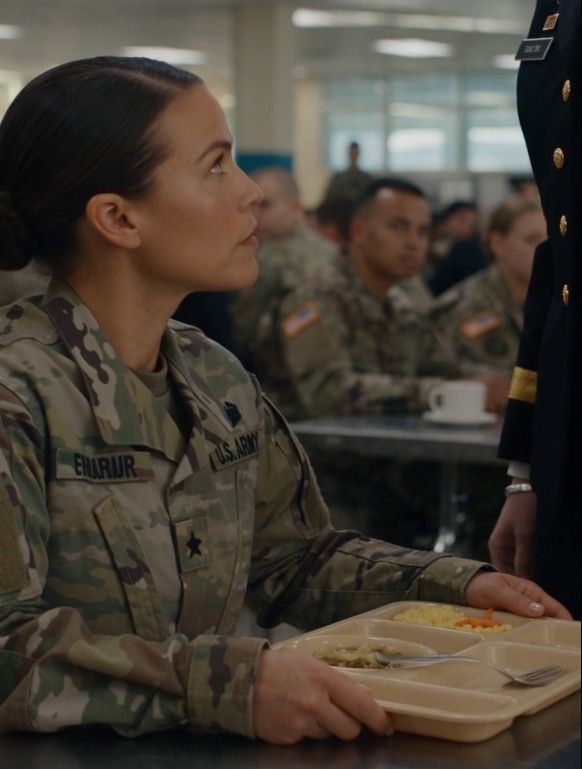
The conversation did not solve hierarchy. It did not need to. It made one expectation clearer: senior people carried more responsibility for creating space to disagree because they were usually the ones who could survive disagreement most easily.
That shifted how several bystanders understood their own role in the cafeteria.
The major who had looked away first requested that future informal working lunches rotate seating and invite the people whose work was actually being discussed, regardless of rank. The civilian analyst began accepting invitations she previously assumed were not meant for her. The young lieutenant volunteered to present a briefing rather than passing the work to someone senior.
None of those choices punished Vanessa.
They reduced the usefulness of the culture she had depended on.
That was a more durable consequence.
Maya noticed the effect at lunch before she noticed it anywhere else. People began asking before assuming a chair was taken. Senior officers still sat together when they wanted to, but the invisible fence around certain tables weakened. A new lieutenant once started to turn away after recognizing the ranks already seated, and the same major who had looked away during Maya’s confrontation waved him back.
“Sit. We have room.”
Nothing about the exchange was heroic. That was why Maya trusted it. Nobody was performing courage for an investigation anymore. They were practicing a different habit after the attention had moved on.
For Maya, that counted as evidence too.
It showed that the room had learned something without needing to keep the worst moment alive forever. The change could become ordinary, which was exactly what she wanted.
Vanessa requested a meeting with Maya.
Maya hesitated before agreeing.
Emily offered to attend.
“No,” Maya said. “I want to hear what she says when she doesn’t have an audience.”
They met in a small conference room with the door open.
Vanessa arrived carrying no papers.
For several seconds she looked at Maya without speaking.
“Do you think I hate junior officers?”
Maya had expected an apology, an accusation, or a defense.
Not that.
“I don’t know what you think about junior officers.”
Vanessa frowned.
“You made me sound like I was enforcing a caste system.”
“I didn’t write that.”
“Others did.”
“Then ask them why.”
Vanessa looked toward the open door.
“I was trying to maintain professional boundaries.”
“By moving my lunch?”
