“I know.”
“Then say that.”
“I will.”
The report created something Vanessa had not expected.
Because she described the lunch as a coordinated disturbance, the facility’s camera footage was preserved before routine overwrite. The video had no audio clear enough to capture every word, but it showed the sequence plainly.
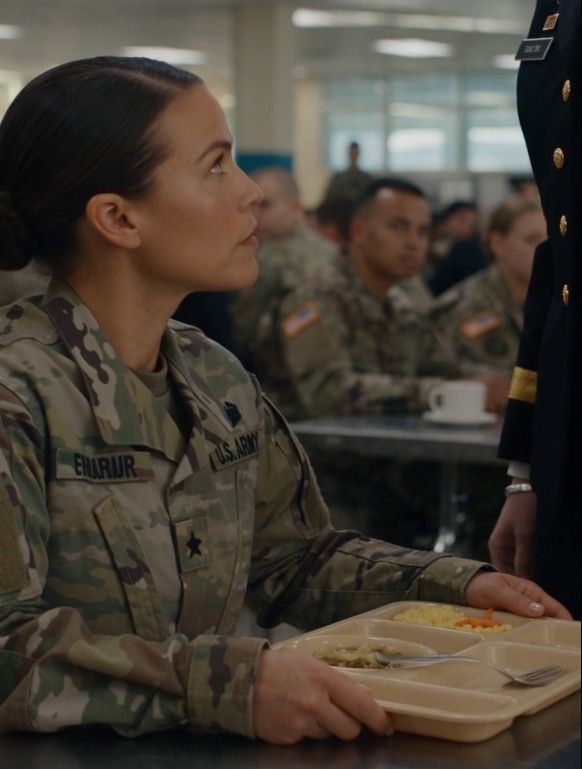
Maya sat.
Vanessa shoved the tray.
Maya stood.
Emily approached alone.
Vanessa blocked the chair.
Emily and Maya walked to the corner.
Only after they sat did other people begin moving, one at a time from different parts of the room.
No signal.
No group meeting.
No coordinated exit.
Most importantly, nobody left the cafeteria.
They ate lunch.
The major’s own allegation had preserved the evidence that weakened it.
An administrative review began, narrow at first.
Was there a senior seating rule?
No written policy existed.
Had Emily disobeyed an order?
She had complied with Vanessa’s ultimatum by not eating at that table.
Had personnel coordinated a protest?
No evidence showed they had.
Why, then, had Vanessa treated the incident as insubordination?
That question widened everything.
Several witnesses admitted they moved because they believed Maya had been treated unfairly. One officer said he had stayed seated for the first minute because Vanessa influenced assignments he wanted. Another said he moved only after he saw Emily accept the consequence without arguing.
A major who had turned his face away during the original confrontation gave the hardest statement.
“I knew there was no seating rule,” he said.
