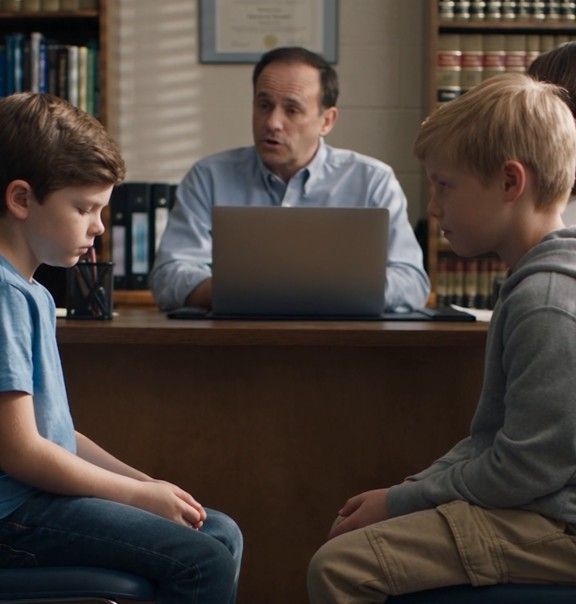
The answer relieved him. Truth did not require endless public retelling to remain true.
Connor’s mother also had to face evidence that contradicted the version she had defended. During the district review she argued that Connor was being unfairly labeled because of normal childhood conflict. Investigators showed her separate clips without commentary. In one, Connor waited until a teacher turned a corner before pulling money from Isaac’s pocket. In another, he kicked Isaac’s shoes beneath a bench and laughed with friends.
She became quieter as the footage continued.
Later, through the school counselor, she sent Megan a short note acknowledging that she had dismissed Isaac’s reports before knowing the facts. Megan read it and put it away. She did not need a friendship or a dramatic reconciliation. An adult who had helped make the room unsafe had finally stopped calling the child ridiculous. That was something, even if it was not everything.
Isaac never saw the note. Megan decided it belonged to the adults unless he asked. He had carried enough adult defensiveness already.
Recovery was less dramatic than the footage. Isaac still flinched when someone walked too close behind him in the hallway. He started carrying lunch money in a zippered pocket even after Connor could no longer approach him. He hated the locker area.
The counselor offered to move his locker.
Isaac said no.
Then he changed his mind the next day.
The new locker was near the library, two hallways away. He expected the move to feel like surrender. It felt like quiet.
Megan replaced his shoes. Isaac wanted to keep the old ones. The laces had been cut and knotted back together.
“Why keep them?” she asked.
“I do not know.”
They went into a box beneath his bed. Months later, Isaac found them and realized he no longer needed proof. He threw them away himself.
Connor’s apology came through a restorative process supervised by the school. Isaac was not required to attend. At first he refused. Later he asked to read Connor’s written statement.
Connor admitted taking money, hiding things, cutting the laces, and pushing Isaac. He wrote that he thought adults believed him because he stayed calm while Isaac got upset. He had learned to provoke Isaac where cameras were assumed not to work and then point to Isaac’s reaction.
Isaac read that sentence twice.
“So he knew,” he told the counselor.
“He knew which reactions helped him avoid consequences,” she said.
“Do I have to forgive him?”
“No.”
“Do I have to hate him?”
“Also no.”
Isaac folded the statement and handed it back.
He chose not to meet Connor.
One of the stranger parts of healing was that Isaac began noticing conflict everywhere once he no longer had to survive his own. A boy in math snapped at a friend over a pencil. Two girls argued loudly in the lunch line. Each time, Isaac’s body braced for an adult to declare everyone equally at fault before asking what happened. Usually, nothing like that occurred. The arguments passed. People apologized. Sometimes a teacher listened to both sides and one child was clearly more responsible than the other.
It helped Isaac relearn scale. Not every disagreement was bullying. Not every shove was part of a four-month pattern. That realization did not minimize what Connor had done; it made the difference clearer. The problem had never been that Connor and Isaac sometimes had conflict. The problem was repetition, targeting, power, and the way adults kept resetting the story to zero after each incident.
The counselor drew a line on paper with dots representing reported events. “This is what happened when each dot was treated alone,” she said, covering the rest with her hand. Then she uncovered the whole line. “And this is what you were trying to describe.”
Isaac stared at it. “A pattern.”
“Exactly.”
He took the paper home and showed Megan. She taped it inside a kitchen cabinet for a month, then asked whether he still wanted it there.
“No,” Isaac said. “I get it now.”
They recycled it. The lesson could stay without turning the house into an evidence room.
His father, who lived in another state, visited during spring break and was furious when he learned the full story. Isaac surprised everyone by telling him, “You do not have to be mad for me the whole time.” They went bowling instead. Isaac bowled terribly. It was one of his favorite days of the year because nobody asked about Connor once.
By spring, school had become ordinary again in small increments. Isaac stopped checking the end of the hallway before opening his locker. He joined robotics club. He sat with two new friends at lunch and sometimes forgot to count the bills in his pocket.
One afternoon Dr. Morris visited his class for a lesson on conflict and bullying. She wrote two phrases on the board: TAKING RESPONSIBILITY and SHARING BLAME.
Isaac felt his stomach tighten. Those words sounded too much like Principal Adams telling him to apologize.
Dr. Morris asked the class what the difference was. Students gave answers. Then she said, “Taking responsibility means naming what you actually did. Sharing blame means making someone else carry part of what you did so you feel less uncomfortable. They are not the same.”
Isaac slowly relaxed.
He raised his hand. “Can two people both do something wrong without it being equal?”
Dr. Morris nodded. “Yes. Context matters. Patterns matter. Power matters. That is why adults have to investigate instead of just saying everyone should apologize.”
After class, Isaac told Megan about it.
She smiled. “Sounds like somebody finally taught the lesson Adams thought he was teaching.”
Isaac laughed.
Near the end of the year, Mr. Lewis asked if Isaac wanted to see the repaired camera system. They stood in the technology room while screens displayed empty hallways.
“See that?” Mr. Lewis pointed. “Storage is redundant now. If one location fails, another keeps the files.”
Isaac nodded as if he understood more than half the explanation.
“Why did you save the old footage?” he asked.
“I did not save it on purpose. The system did.”
“Still. Why did you tell them?”
