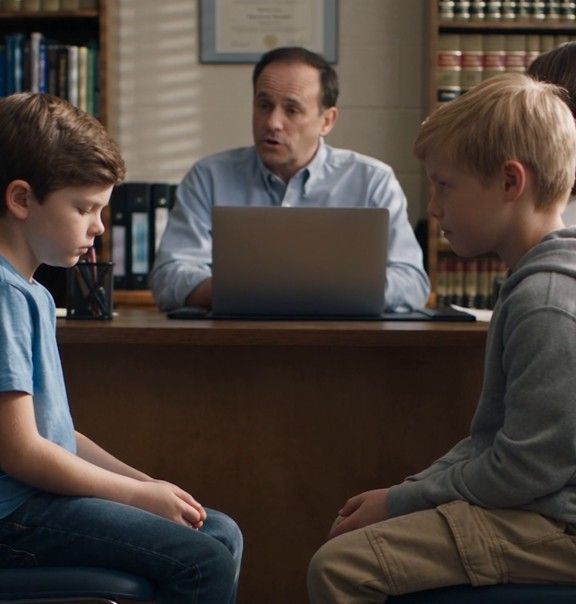
Adams looked at him. “Leave the drive.”
“I already made a copy for the district technology office when I discovered the storage issue.”
That sentence changed the balance in the room. The footage could not disappear into an office drawer.
Megan took out her phone. “I want the district superintendent contacted now. I also want the suspension decision for Isaac put on hold until these recordings are reviewed.”
Adams started to say school procedure required—
“You just became part of the evidence,” Megan said. “You do not get to be the only person deciding procedure.”
For once, Principal Adams had no quick answer.
The superintendent arrived within an hour with the district’s student-services director. Connor and his mother were asked to wait separately. Isaac stayed with Megan. The custodian provided the drive and explained the malfunction: a camera-management update had caused staff to believe recordings near Isaac’s locker were not saving. In reality, the system had been writing to an older storage partition.
Months of video remained.
The district secured the files before anyone reviewed them in detail. Then Isaac was sent home for the day with no suspension issued.
In the car, Megan gripped the steering wheel. “Why did you not tell me you reported the money?”
Isaac stared out the window. “You were already calling the school all the time.”
“That is my job.”
“Connor said if I kept telling, everyone would know I needed my mom to fight for me.”
Megan swallowed. “And what did the school say?”
“That we both needed better conflict skills.”
She pulled into their driveway and turned off the engine. “Isaac, fighting back today can still be something we talk about. But I need you to hear this: defending yourself after months of being targeted is not the same story as what he has been doing to you. Adults should have separated those things sooner.”
Isaac looked at his frayed shoelace. “Am I still in trouble?”
“We will find out what the school decides. But you are not facing that meeting alone again.”
The district review lasted two weeks. Investigators watched hours of hallway footage and compared it with incident reports. The pattern was worse than Megan expected. Connor took lunch money on multiple days. He hid Isaac’s belongings, cut his shoelaces in the locker area, shoved him twice, and repeatedly used friends to block him from reaching class.
More troubling was the adult pattern. Principal Adams was visible during or immediately after six separate incidents. In three, Isaac approached him. The written reports described the events as minor peer conflicts or did not mention Isaac’s allegation at all.
Emails showed that teachers had raised concerns too. One wrote that Isaac seemed anxious around Connor. Another reported seeing Connor demand food from him. Adams replied that the boys had a “mutual conflict” and should be encouraged to resolve it.
Why?
The answer was not a secret bribe or dramatic conspiracy. It was an ordinary failure made powerful by authority. Adams believed Connor’s mother, who had complained aggressively whenever her son was disciplined, and he believed Isaac was reactive because Isaac sometimes shouted or pushed back. He wanted fewer parent confrontations and fewer formal bullying reports. So he chose the interpretation that created the least paperwork: two boys who simply did not get along.
That choice became a pattern.
Every time new evidence appeared, Adams fit it into the old story instead of reconsidering the story.
The district placed him on administrative leave during the review. After the findings were completed, he was removed as principal and reassigned away from student discipline while employment procedures continued. The district cited failures to respond to repeated reports and inaccurate classification of documented bullying incidents.
Connor also faced consequences. He was suspended for the physical assault that day and for confirmed prior conduct, then returned under a safety plan that kept him separated from Isaac. His mother fought the findings, but the video ended arguments that had previously depended on whose child sounded more convincing in an office.
Isaac’s own punch was addressed too. A counselor told him clearly that hitting was not the response the school wanted. But the district did not suspend him after determining he had been shoved into a locker and reacted during an established pattern of bullying that adults had failed to stop.
The distinction mattered to Isaac.
