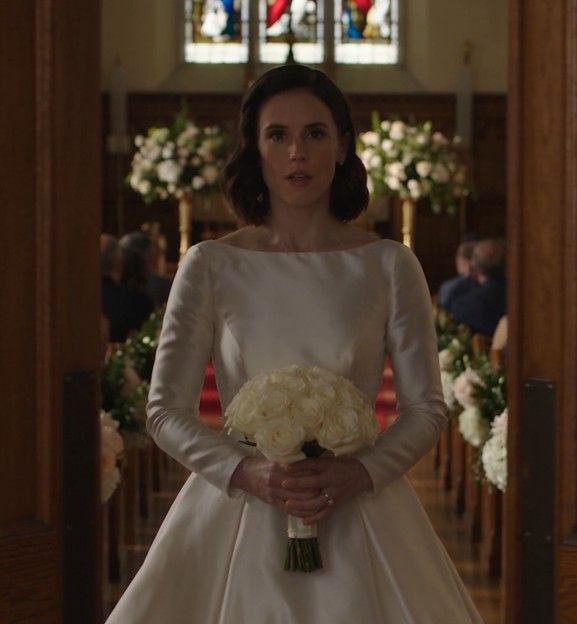
“Helen called me,” she said, her hands twisting. “She said you were going to do this today. I told myself you wouldn’t want me here. That I’d ruin it. But I… I sat in the parking lot and I couldn’t…”
She looked at Claire’s dress, at the crushed paper, at the tears drying on her face.
“You look so much like him when you’re brave,” she whispered.
Claire stared. For years she had imagined this moment as an angry speech. Now there was no anger. Just a tired woman and a daughter in a wedding dress that would never be used for a wedding.
“You came,” Claire said.
Her mother nodded, tears finally breaking. “I came.”
Claire reached out — hesitantly, then all at once — and her mother stepped forward and took her hands. Her mother’s hands were cold. Claire warmed them.
A soft cough came from the altar. Agent Reyes had returned alone. He approached Claire with careful deference.
“Ms. Hartwell, we have Mr. Caldwell in custody,” he said quietly. “We found the forged notary seal in his briefcase in your home, along with drafts of the sale agreement to Meridian Corp. He was planning to sell the guidance system patent offshore by next week. The transfer would have gutted your company and voided the charitable pricing clause your father put in for hospitals.”
Claire closed her eyes for a second. The scale of it hit her — not just betrayal, but how many patients, how many surgeons, how many small hospitals would have lost access.
“Will he go to prison?” she asked.
“He’s facing multiple federal charges,” Reyes said. “With the evidence you and Ms. Chen preserved, and the forensic proof, yes. For a long time. And the sale is void. Your company is safe.”
He hesitated, then added, more gently, “You did an extraordinarily brave thing today, Ms. Hartwell. Most people wouldn’t have.”
Claire looked down at her mother’s hands still in hers, at Helen’s roses, at her father’s letter.
“I was terrified,” she admitted.
Reyes smiled a little. “Brave people usually are.”
He stepped back to give her space.
The priest came forward again and, without asking, simply placed a hand lightly on Claire’s shoulder and said, “The chapel is yours for as long as you need it, child.”
Claire turned to look at the room — at the people who had come expecting a fairy tale and had witnessed an ending instead.
She took a deep breath. The air smelled like lilies and old wood and melting candle wax.
“I don’t want a wedding today,” she said, and her voice carried, clear and calm, to every pew. “I wanted to tell the truth in a room where no one could pretend they didn’t hear it.”
She lifted her father’s letter just slightly.
“My father built this company so that a surgeon in a rural hospital could have the same tools as a surgeon in a big city. That was his promise. Ethan tried to sell that promise. He failed.”
She looked at Helen, at Albright, at her mother, at Maya.
“I’m not going to pretend today didn’t happen. I’m not going to have champagne and pretend we’re celebrating. But I would like—” Her voice wavered and she steadied it. “I would like everyone who came here, who works for Hartwell, who cared about my dad, to stay for a little while. Not as wedding guests. As family. We have a lot to talk about. And I think we should eat the cake. It cost a fortune.”
A startled, wet laugh broke from somewhere in the middle pews. Then another. Maya laughed through tears. Helen laughed and wiped her face with her sleeve.
The tension in the room, that awful, glittering, entertained silence from the beginning, finally, completely dissolved.
People stood. Not to leave. To come closer.
Mr. Patel was the first to reach the altar, but he didn’t speak. He just bowed his head to Claire. One by one, employees, friends, nurses who had worked with the Hartwell devices, came up the aisle — not in a receiving line, but in a slow, quiet gathering around her, as if drawn to warmth.
Her mother never let go of her hand.
