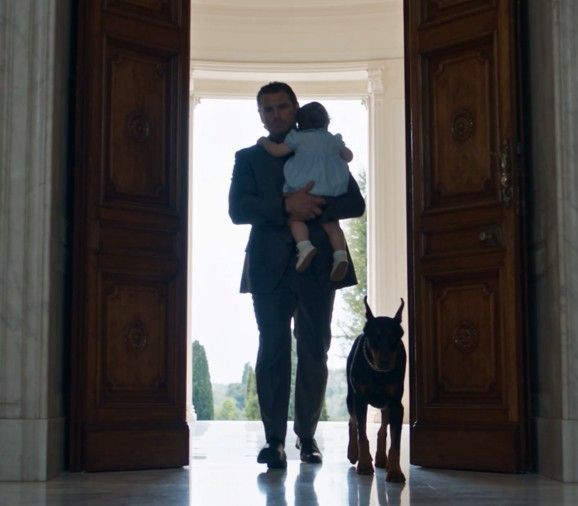
And what I would do to protect the woman who wore it.
What was she really hiding behind that false identity, and who was coming for her next?
I set the little girl down gently.
She ran to her mother and buried her face in the folds of her wrinkled uniform.
The woman — whoever she truly was — dropped to her knees and wrapped both arms around her daughter like the child might disappear if she let go.
I turned slowly toward Renata.
She hadn’t moved. Her hands were clasped in front of her waist. Her posture was perfect, her face blank, her breathing controlled.
But there was a pulse hammering at the side of her throat.
“Everyone out,” I said quietly.
The staff scattered. Security moved toward the side doors without a word.
Within thirty seconds, the hall was empty except for the five of us: me, the woman, the child, Renata, and my Doberman sitting motionless at my heel.
I let the silence stretch.
The woman stood slowly, lifting her daughter into her arms. The child’s face was still wet with tears, but she had stopped crying. She watched me with wide, dark eyes.
“You recognize her,” I said to Renata.
It wasn’t a question.
Renata’s jaw tightened. “Sir, I don’t know what—”
“Don’t.”
My voice cut through the air like a blade.
She stopped mid-sentence.
I walked toward her slowly, each footstep echoing against the marble floor.
“You’ve worked for me for eight years,” I said. “You’ve been efficient. Loyal. I trusted you with the operations of this house.”
I stopped two feet in front of her.
“So I’m going to give you one chance to tell me the truth.”
Her lips parted. Her eyes flicked toward the woman behind me, then back to my face.
“Who told you to get rid of her?”
Renata’s breathing quickened.
“No one, sir. I only wanted to protect the household from—”
“Her name.”
My voice dropped to something colder than I’d used in years.
Renata flinched.
