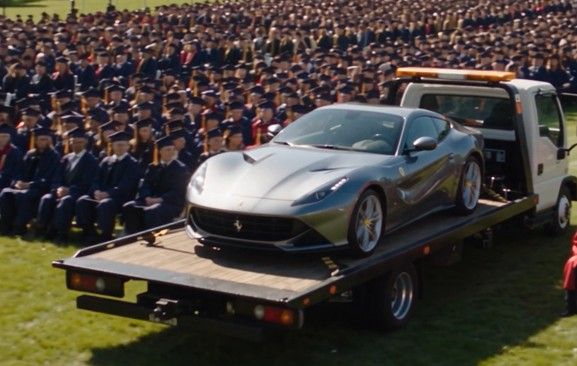
Later that night, we went back to my apartment. She kicked off her shoes in the hallway exactly as she had done since she was six.
I dropped my keys into the wooden bowl.
The old Ferrari fob shifted beneath them with a soft metallic sound.
Maya heard it and smiled.
“Still keeping that?”
“Apparently.”
She leaned her head against my shoulder for one second before walking toward the kitchen.
“Good.”
I stood there beside the open door, looking at the little bowl full of ordinary keys.
The most expensive one had never opened the place that mattered.
That door had been open for seventeen years already.
The bowl became a family joke after that. Whenever Maya visited, she would glance inside to see whether the Ferrari shell was still there beneath grocery-store loyalty cards, loose coins, and the key to a bicycle lock. Once, Evelyn saw it during a carefully arranged visit and stopped in the hallway.
“I gave you that,” she said to Maya.
“You gave me the car,” Maya replied. “Mom kept the part that became useful.”
Evelyn almost smiled.
Then she looked at me. “May I ask what it means to you?”
I thought about the commencement lawn, the security guard’s hand against my shoulder, the terror that wealth might rewrite seventeen years in a single afternoon.
“It means expensive things can still be empty,” I said. “And ordinary things can open a home.”
Evelyn lowered her eyes.
“That is fair.”
It was not reconciliation. It was something quieter: a sentence she accepted without defending herself.
By then, Maya no longer needed either of us to define the relationship for her. She called me when she was exhausted after night shifts. She met Evelyn for coffee when she chose. She managed her trust through independent advisers and reviewed the Open Door Fund’s annual reports herself. Biology, money, history, gratitude—none of them got to own her whole identity.
On the fifth anniversary of her graduation, Maya sent me a photograph from the pediatric clinic where she worked. A little girl had drawn a house in crayon and taped it beside Maya’s desk. The roof was purple. The windows were crooked. The front door was enormous.
Under the picture, Maya had written four words for me:
Doors Matter More Than Cars.
I printed the photograph and tucked it beneath the old Ferrari fob in the bowl.
That evening, when I came home from my nursing shift, I unlocked the apartment with an ordinary brass key. The silver shell clicked softly beneath it as I dropped the keys inside.
Then I closed the door, not because I feared anyone taking my daughter away, but because I knew with complete certainty that when Maya came home, she would open it herself.
