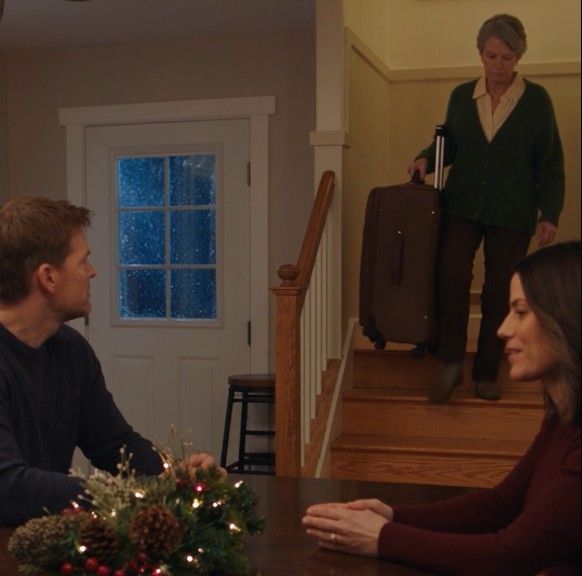
We didn’t talk about the house again that night. We ate the pie Ruth had brought, which had gone cold. We let the children open one present each, as Henry and I had always allowed on Christmas Eve. Lily gave me a drawing of the house with all of us holding hands in front of it, the snow made of glued cotton balls.
Later, after the dishes were done and the children were sleepy on the couch under blankets, Brian asked if he could speak to me alone.
We went into the kitchen. The light there was yellow and warm. The snow outside the window glowed blue.
He stood with his back against the counter, his hands gripping the edge.
“Mom, I will fix this,” he said. “I will pay the deposit back. I will tell Hillside Manor there was a misunderstanding. I will go to the bank with you and show them the trust so Melissa can’t… so no one can…”
He stopped, his breath hitching.
“I don’t want your house,” he whispered. “I want you to be proud of me again.”
I reached up and touched his face. He was a grown man, taller than Henry had been, but his cheek was still soft.
“I am proud when you are kind,” I said. “That is all I ever needed.”
He nodded, tears spilling over.
“Will you let me stay here for a while? Not to live off you. Just… Melissa and I need to talk. About a lot of things. I don’t want to go home tonight and pretend.”
“Ruth and Daniel will stay, too,” I said. “We will all stay. This house has enough rooms.”
He laughed wetly.
For a long time we just stood there, mother and son, listening to the house settle, to the faint sound of the Christmas tree lights buzzing.
Later, when everyone had gone to bed — Ruth in the guest room, Daniel on the air mattress in the den, the children curled together, Melissa quiet on the couch with a blanket I had placed over her without a word, Brian asleep in his old childhood room — I walked back to the living room alone.
The tree was still lit. The blue folder was safe in its drawer. The suitcase stood by the fireplace, empty now, its gifts distributed, its purpose fulfilled.
I picked up the small flat box that still held the blue sweater. Melissa had not taken it to the couch. She had left it on the table, as if she wasn’t sure she was allowed to accept it.
I carried it to her.
She was awake, staring at the ceiling, her eyes puffy.
I knelt beside the couch and placed the box beside her hand.
She turned her head. Our eyes met in the soft, blinking light.
“You don’t have to wear it,” I whispered. “But it was made with love. That part is yours whether you want it or not.”
She stared at the box. Slowly, hesitantly, she reached out and touched the yarn through the open lid. Her fingers trembled.
“Thank you,” she mouthed, no sound coming out.
I nodded.
When I went back to my bedroom, I passed Henry’s portrait. I stopped.
For three years I had thought the twist in our story was that Henry had left me the house to protect me.
But standing there in the quiet, with my family — imperfect, hurting, still here — breathing under my roof, I understood the real twist had been Henry’s last gift all along.
He hadn’t just left me a house.
He had left me the strength to keep the door open, even after someone tried to close it on me.
