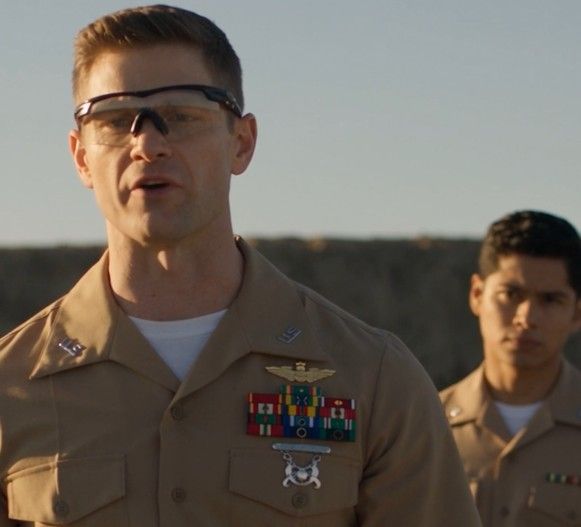
Daniel looked toward the empty firing lane.
“Because I laughed the first time he told you to stay in your responsibility. I want to remember how quickly that felt normal because he was confident.”
Sarah studied him for a moment.
Then she handed him the flag.
“Keep it somewhere useful. Not as a trophy.”
“Understood.”
The range commander asked Sarah to join the investigation debrief.
She hated those meetings.
People often wanted a clean story: maintenance expert right, arrogant shooter wrong, lesson learned.
Sarah refused the simple version.
“The system failed in layers,” she said. “The axle bent. The sensor compensated. The request sat unread after it was opened. The safety boundary was treated like tape on the ground instead of a control. The trainees saw a lieutenant ignore the process and assumed that made the process optional.”
The commander nodded.
“What would you change?”
Sarah gave him a list.
Safety-critical maintenance requests would now require explicit acknowledgment rather than passive delivery. An unresolved critical request would automatically lock the affected lane in scheduling software until maintenance and range safety cleared it. Warning boundaries could not be removed by instructional staff while an active work order remained open.
Most important to Sarah, stop-work authority was clarified.
Any person who observed a credible mechanical or safety problem could call for a pause without being punished merely because the concern turned out to be wrong.
“That will be abused,” one officer said.
Sarah shrugged.
“Then manage abuse. Do not make fear of inconvenience the reason people stay quiet around machinery.”
The policy was adopted.
Training slowed for a week while everyone learned it.
Then it became ordinary.
That was success.
The new process revealed how much of Sarah’s job had previously depended on personality. Some instructors had always listened to maintenance because they trusted individual technicians. Others listened only after a senior officer repeated the same warning. That was fragile. A safe system could not depend on whether the person carrying the wrench was famous, forceful, or personally liked.
Sarah had spent twenty-four years learning that lesson in less dramatic ways. She began as an electronics technician working on simple target controls, then moved into mechanical diagnostics as the ranges became more automated. She had seen expensive equipment fail because one small vibration was dismissed as normal. She had also seen technicians call shutdowns that turned out to be unnecessary.
Being wrong sometimes was part of the job.
The important thing was creating a process where a wrong warning cost time and a ignored correct warning did not cost people.
During the first month of the new policy, the range paused seven times for reported issues. Five were minor and cleared quickly. One came from a sensor cable that only needed reseating. One revealed a cracked mounting bracket before it failed under load.
Some instructors complained about lost minutes.
