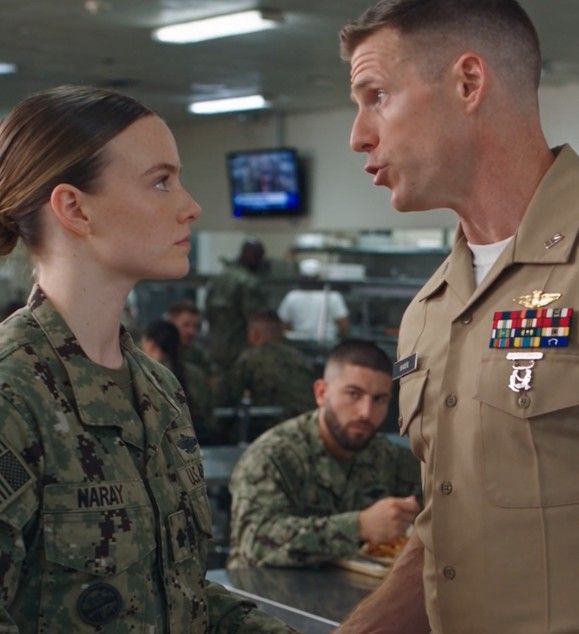
Emma answered the same way every time.
“If your standard depends on cruelty, it is not a standard. It is a personality.”
The changes did not make Emma’s own evaluation easier. If anything, they made her more visible. Every failure risked being interpreted through the cafeteria incident, either as proof that Bennett had protected her or as proof that Mason had been right to doubt her. Emma refused both stories.
During a night navigation exercise in heavy rain, she missed a checkpoint by nearly four hundred meters. Nobody dumped her meal. Nobody mocked her in front of the group. The evaluator simply showed her the error and told her she had forty minutes to recover.
Emma did.
The next week, she failed a timed equipment problem because she chose the wrong sequence under fatigue. She wrote the mistake into her notebook, repeated the event, and passed on the second attempt.
That mattered to Parker, who had quietly assumed that protecting someone from humiliation meant lowering the consequences of failure. Watching Emma work changed his understanding. Standards could be severe without becoming personal. A person could be told, clearly and without cruelty, that performance was not good enough. Then the work could continue.
One afternoon, Parker said as much while they packed gear.
“I think I had the whole thing backward.”
Emma tightened a strap. “Which whole thing? You have several.”
“Cole used to say pressure reveals people. I thought what happened to you was just too much pressure.”
“It was not pressure.”
“I know that now.”
She looked at him.
Parker searched for the words. “Pressure comes from the task. Sometimes from the stakes. Humiliation comes from the person who wants an audience.”
Emma nodded. “Better.”
“Do I get a grade?”
“No.”
“Harsh standard.”
They laughed.
Her most important evaluation came during a multi-day field problem when Ruiz injured his ankle crossing broken terrain. The injury was not catastrophic, but continuing at the same pace risked making it worse. The team was already behind. Stopping would damage their score.
Ruiz insisted he could continue.
Emma examined the swelling and told the evaluator the team needed to redistribute his load and slow the movement.
“That will cost you,” the evaluator said.
“I know.”
“He says he can walk.”
“He can. That is not the same as saying the plan should stay unchanged.”
The evaluator nodded once and recorded the decision.
The team finished late. Their score dropped.
Emma expected criticism at the debrief. Instead, the evaluator asked why she had accepted the penalty.
