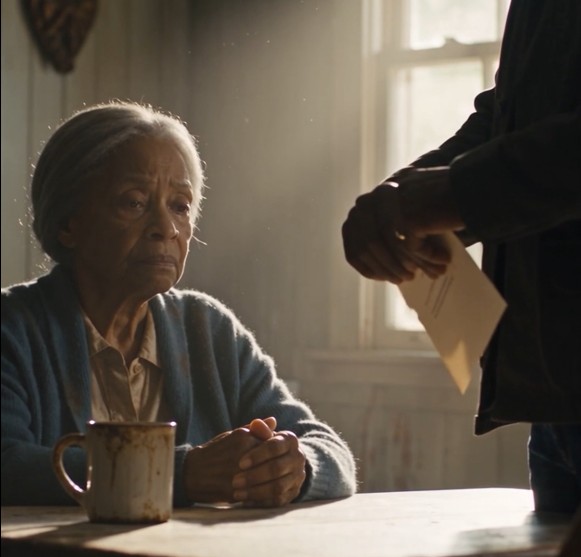
“No,” she said, surprising herself with the certainty of it.
Her son called four times that week. She answered the fourth.
“I lost the deposit,” he said.
“I’m sorry you lost your money.”
The silence that followed told her he had expected more.
Then he said, “Can we talk?”
“With Ruth here.”
“Do we really need that?”
“Yes.”
He arrived the next Tuesday wearing the same charcoal jacket. This time he waited on the porch until she invited him inside.
Ruth sat beside the window. The replacement letter lay on the table.
Evelyn told him she intended to sell.
He stared at her.
“You’ll sell to strangers, but you wouldn’t transfer it to me?”
“I will be paid by strangers.”
“I could have made payments.”
“With what?” Ruth asked gently.
His mouth tightened.
Evelyn kept her eyes on him.
“Tell us.”
He looked down at his hands.
There were credit-card balances. A personal loan. More money committed to the business than he had admitted. The lost deposit had been borrowed, too.
For several seconds, Evelyn could only hear the clock.
He had not merely wanted a head start. He had wanted her house to conceal how far behind he had fallen.
“If you’d told me,” she began, then stopped.
He leaned forward.
“What?”
She thought of another loan, another quiet sacrifice, another explanation she could invent to keep him from feeling ashamed.
Then she saw the torn letter again.
“I would have worried,” she said. “But I would not have signed.”
He looked at Ruth as though she had put those words in Evelyn’s mouth.
Ruth said nothing.
“This is between me and my mother.”
“It is,” Evelyn said. “So look at me.”
He did.
“I am selling because I need a home I can manage and money I can live on. You will not receive the proceeds. I will not guarantee your debts.”
“So that’s it?”
“That part is.”
“And everything you did for me means I spend the rest of my life owing you?”
Evelyn flinched.
