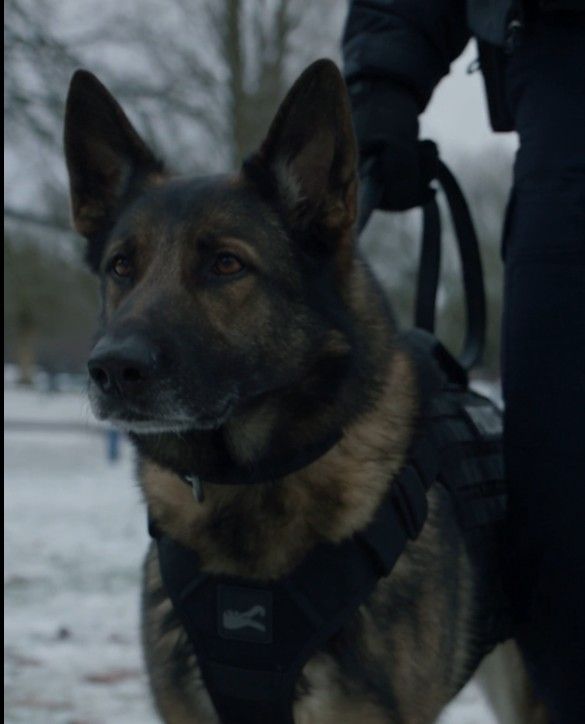
He tilted his head.
“You’re under investigation, partner.”
His tail thumped once.
“I know. Very serious.”
My wife found us there and handed me coffee.
“You realize he has no idea what you’re saying.”
“He knows tone.”
“Your tone says you are more upset than he is.”
She was right.
I kept replaying the moment the leash tore through my hand. What if Lily had been closer to pavement? What if Titan had hit her differently? What if the snake had struck him? What if the man with the branch had reached them two seconds sooner?
A good outcome did not make every risk disappear.
That was the part social media did not understand.
By the second day, a video had spread online under a headline claiming a police dog “attacked” a child before a heroic crowd discovered a snake. Another version claimed I had ordered Titan to attack. A third claimed Lily had been bitten and Titan killed the snake.
None was true.
Lily’s mother, Rachel, called the department and asked whether she could make a statement.
She did not owe us one.
But she stood beside an officer at a small press briefing and said, plainly, that Titan knocked her daughter down and kept her from rising because a rattlesnake was beside her face.
“I was screaming at the handler to get the dog off,” she admitted. “If he had listened to me immediately, my daughter might have sat up into the snake.”
I watched from home.
Titan slept with his head on my boot.
Rachel continued.
“I was wrong about what I was seeing. I am grateful the officer looked twice. I am grateful the dog did not wait for us to understand.”
That sentence stayed with me.
The review cleared Titan to return to duty, with one training recommendation for me: improve response protocols for scent-detected environmental threats during community events. Police dogs were trained for suspects, explosives, narcotics, and officer protection. Titan had improvised outside the neat boxes of policy.
We spent the next several weeks turning improvisation into something teachable.
Animal control brought training aids. We worked on snake avoidance, alert behaviors, and handler recognition. Titan learned a new signal: instead of charging a stationary wildlife threat, he would freeze, orient, and bark when distance allowed.
I learned the harder lesson.
A command is not magic.
Handlers depend on obedience because lives depend on predictability. But working dogs are not remote-controlled machines. They perceive parts of the world we cannot. My job was not only to make Titan obey. It was to understand when his behavior contained information.
That did not mean letting him ignore commands whenever he wanted.
