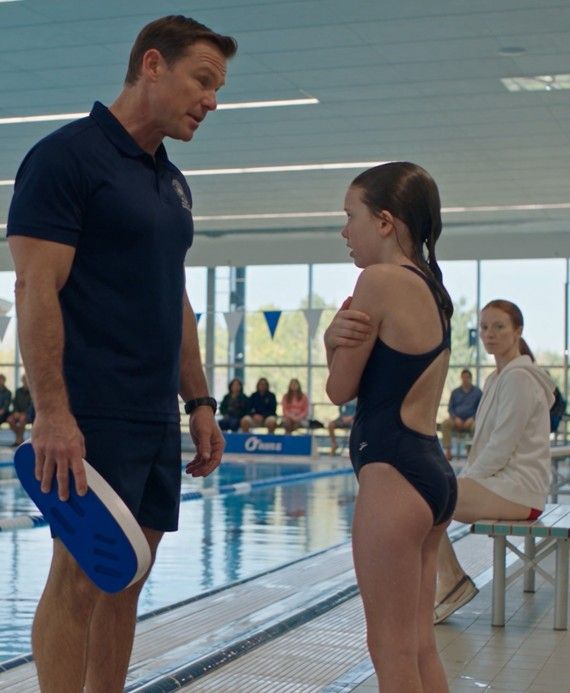
Another swimmer raised her hand as if they were in class. “He made Mia get back in after she threw up last month.”
Bryan snapped, “Enough.”
The lifeguard turned. “No. Practice is over. Everyone out of the water.”
For the first time, Bryan had no authority over the deck. The lifeguard radioed the facility manager and requested that the camera footage be preserved immediately. Ellie’s mother wrapped the towel more tightly around her daughter.
“Can you breathe?” she asked.
Ellie nodded, though her chest still felt narrow.
“We are going to urgent care,” her mother said.
Bryan scoffed quietly. “She is talking normally now.”
Ellie’s mother turned. “You are no longer part of my daughter’s medical decisions.”
That sentence made Ellie feel safer than the towel around her shoulders.
At urgent care, the doctor listened to her lungs, reviewed the history of symptoms during intense practice, and told them the episode needed follow-up. Ellie’s scheduled appointment was moved sooner. Two days later, after evaluation and testing, she was diagnosed with exercise-induced bronchoconstriction and given a treatment plan for swimming.
Ellie stared at the doctor. “So it was not nerves?”
The doctor answered carefully. “Anxiety can make breathing feel harder, but your symptoms have a physical component we can treat. You did the right thing by stopping when you felt you could not breathe safely.”
Her mother looked away because she was crying.
Ellie felt angry instead. She had spent three weeks wondering whether she was lazy, dramatic, or afraid of a sport she loved. An adult had given those possibilities more weight than the sensation inside her own chest.
The pool facility suspended Bryan from coaching while it reviewed the recordings. Parents were notified that concerns about athlete safety had been raised. They were invited to report specific experiences.
The camera footage did not record every word. Noah was right about that. It did not need to.
Video showed Bryan blocking children from leaving lanes, gesturing angrily when swimmers stopped, pushing Ellie toward the edge on the day she could not breathe, and ordering Mia back toward the water after she became visibly ill. In another clip, a child sat on the deck holding an ankle while Bryan pointed toward the pool. A lifeguard eventually intervened.
The facility compared those recordings with written incident logs. Several lifeguards had documented disagreements with Bryan, but managers had treated them as personality conflicts between staff and a demanding coach. Once the clips were viewed as a pattern, the meaning changed.
Then the children’s statements added what cameras could not hear.
Bryan told them that complaints from parents made practices harder. He threatened relay positions. He called stopping “quitting.” He said pain was a test of commitment. He repeatedly suggested that symptoms were excuses until an adult outside the team confirmed otherwise.
Ellie gave one statement with her mother nearby. She described the warning that she could lose her relay position if she kept “pretending.” She admitted she had not told her mother because she was afraid the team would be punished.
Her mother’s face tightened. “You thought protecting the team meant hiding from me?”
Ellie nodded.
The investigator interrupted gently. “That is a question for later. Right now Ellie is doing exactly what we need: telling what she remembers.”
Her mother apologized. “You are right.”
That small correction mattered to Ellie. Adults could become emotional and still let the child’s account remain hers.
Bryan defended his methods as demanding coaching. He said competitive swimming required resilience and that parents misunderstood intensity. The review distinguished intensity from safety. A hard set was not the issue. Ignoring breathing complaints, discouraging medical disclosure, and threatening children for seeking help were.
The facility terminated his coaching contract and reported the findings to the governing bodies responsible for youth-program eligibility. He was barred from coaching at the facility. The team’s board also adopted rules requiring that health-related stops be honored immediately until a qualified safety or medical professional cleared the athlete to continue.
Ellie expected to feel victorious. She did not.
She felt guilty.
“What if he never coaches again because of me?” she asked her mother.
“The decision was based on what he did with many swimmers.”
“But I started it.”
The lifeguard, Tasha, visited one evening to return a swim bag left at the pool. She heard the question.
“You did not start anything,” Tasha said. “You stopped in the middle of something that had already been happening.”
Ellie looked at her.
“There is a difference.”
The team paused practices for a week. When they resumed, an interim coach named Ms. Ramirez met with parents and swimmers together. She did not begin with a speech about winning. She began with a hand signal.
“If you need to stop for safety, this is the signal,” she said, raising one hand. “You use it. I acknowledge it. We figure out why after you are safe. No one loses a relay spot for using it.”
Noah raised his hand. “What if somebody abuses it?”
Ms. Ramirez nodded. “Then we address that behavior separately. We do not make every child prove an emergency before being allowed to stop.”
Ellie liked her immediately, then distrusted herself for liking a coach immediately.
She returned to the pool with her new treatment plan and a rescue inhaler managed according to the doctor’s instructions and facility policy. The first practice terrified her. Not because of the water. Because she knew the moment might come when her chest tightened and everyone would watch.
It came twenty minutes in.
Ellie felt the familiar narrowing. Her brain produced Bryan’s voice before any real person spoke. Finish. Stop pretending. Confidence.
She raised her hand.
Ms. Ramirez blew one short whistle and pointed to the wall. “Out and check in.”
No anger. No eye roll. No speech.
Ellie climbed out. Tasha checked on her. They followed the plan. She recovered.
