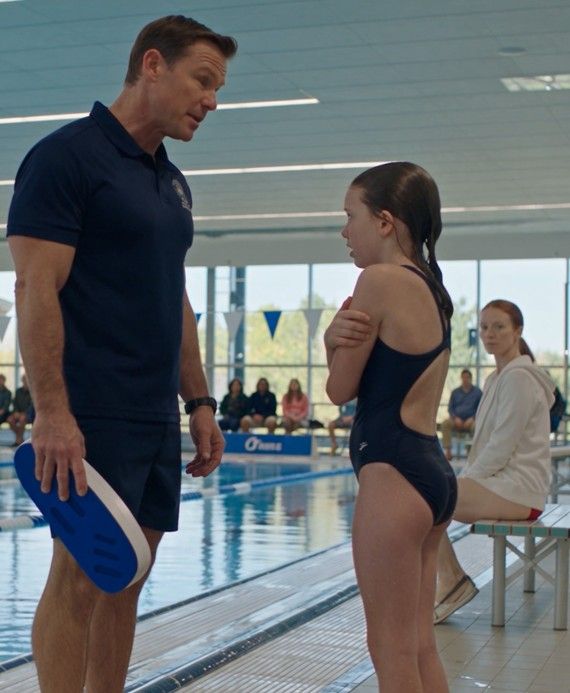
The lifeguard stepped between him and the family. “No one has accused you of anything beyond what happened in front of us. She said she could not breathe. You tried to push her back toward the water.”
“I put a hand on her shoulder.”
“The camera can show what you did.”
The coach’s eyes moved toward the office.
Ellie’s mother saw it. “And the other practices?”
Bryan did not answer.
The twelve-year-old boy who had spoken up climbed out of the pool. His name was Noah. Water ran from his hair onto the deck.
“He tells us the cameras do not have sound,” Noah said.
The lifeguard looked at him. “Why would he tell you that?”
Noah shrugged, suddenly nervous. “When he gets mad. He says parents only see what happens at meets.”
Another swimmer raised her hand as if they were in class. “He made Mia get back in after she threw up last month.”
Bryan snapped, “Enough.”
The lifeguard turned. “No. Practice is over. Everyone out of the water.”
For the first time, Bryan had no authority over the deck. The lifeguard radioed the facility manager and requested that the camera footage be preserved immediately. Ellie’s mother wrapped the towel more tightly around her daughter.
“Can you breathe?” she asked.
Ellie nodded, though her chest still felt narrow.
“We are going to urgent care,” her mother said.
Bryan scoffed quietly. “She is talking normally now.”
Ellie’s mother turned. “You are no longer part of my daughter’s medical decisions.”
That sentence made Ellie feel safer than the towel around her shoulders.
At urgent care, the doctor listened to her lungs, reviewed the history of symptoms during intense practice, and told them the episode needed follow-up. Ellie’s scheduled appointment was moved sooner. Two days later, after evaluation and testing, she was diagnosed with exercise-induced bronchoconstriction and given a treatment plan for swimming.
Ellie stared at the doctor. “So it was not nerves?”
The doctor answered carefully. “Anxiety can make breathing feel harder, but your symptoms have a physical component we can treat. You did the right thing by stopping when you felt you could not breathe safely.”
Her mother looked away because she was crying.
Ellie felt angry instead. She had spent three weeks wondering whether she was lazy, dramatic, or afraid of a sport she loved. An adult had given those possibilities more weight than the sensation inside her own chest.
The pool facility suspended Bryan from coaching while it reviewed the recordings. Parents were notified that concerns about athlete safety had been raised. They were invited to report specific experiences.
The camera footage did not record every word. Noah was right about that. It did not need to.
Video showed Bryan blocking children from leaving lanes, gesturing angrily when swimmers stopped, pushing Ellie toward the edge on the day she could not breathe, and ordering Mia back toward the water after she became visibly ill. In another clip, a child sat on the deck holding an ankle while Bryan pointed toward the pool. A lifeguard eventually intervened.
The facility compared those recordings with written incident logs. Several lifeguards had documented disagreements with Bryan, but managers had treated them as personality conflicts between staff and a demanding coach. Once the clips were viewed as a pattern, the meaning changed.
Then the children’s statements added what cameras could not hear.
