They also asked a neighbor Jonah already knew if she could be a paid backup for the remaining late days. It cost money they had not planned to spend.
The first evening the neighbor picked him up, Jonah packed his own backpack twice. He checked the zipper, the homework folder, and the house key clipped inside. His mother noticed but did not tell him he was worrying too much. She showed him the schedule written on the refrigerator instead: who would meet him, what time she expected to finish, and who to call if any part changed. Predictability, they discovered, did more for him than repeated promises that everything would be fine.
At school, his teacher noticed another change. Jonah had always volunteered for classroom jobs, but now he asked whether other students were taking turns. The question sounded small. To his mother, it was proof that he had begun noticing the difference between generosity and being assigned usefulness as a condition of belonging. When the teacher asked if he wanted to carry a box of library books, Jonah said, “Not today.” Nothing bad happened. He came home and told his mother about it as if reporting a miracle.
Walt had his own reckoning. During Sunday visits he had seen Jonah’s quick smile, the one that appeared whenever an adult asked whether he was okay. Walt had admired the boy for being easygoing. Now he understood how much information that smile had hidden. He began resisting the urge to accept the first polite answer. If Jonah said he was fine while staring at the floor, Walt waited. Sometimes Jonah truly was fine. Sometimes a second answer came later.
None of the new arrangements were as convenient as leaving Jonah with Diane. That fact became important too. Safety did not arrive as a perfect solution that cost nothing. It arrived as schedule swaps, gas money, awkward favors, Walt’s aching hip, and a neighbor’s paid hours. Jonah watched the adults absorb those difficulties without once handing them back to him as a debt. Slowly, he stopped expecting every inconvenience to become evidence that he was too much.
His mother stopped apologizing every time work made a day complicated. Instead she named the complication and the plan. “I’m late; Walt has you.” “My shift changed; Mrs. Alvarez will pick you up.” Jonah noticed how different those sentences felt from “I’m sorry again.” The problem stayed real, but it no longer sounded like a moral failure shared between them. Jonah began to understand that adults could be tired, short on time, or worried about money without needing a child to become smaller in order to fix those feelings. That lesson stayed with him.
For several weeks, Jonah’s mother rewrote the grocery totals on the backs of envelopes.
This time, when Jonah saw them, she told him plainly what the new expense meant. Fewer takeout nights. No new winter coat for her until January. Careful planning.
Not disaster.
Not his fault.
Diane called repeatedly.
At first she was angry. Then hurt. Then apologetic in a way that still contained explanations.
She said Jonah was sensitive because he was under stress. She said she had been trying to support her sister. She said everyone in the family had chores growing up. She said the plate by the back door had been temporary.
Jonah’s mother listened once.
Then she said, “You are describing your intentions. I am talking about what you did.”
After that, she stopped debating.
Diane was not allowed to supervise Jonah.
Family gatherings changed too.
Walt refused to attend the next Sunday dinner at Diane’s house. He invited everyone to his smaller apartment instead, even though fitting the family around his table required folding chairs from the church basement.
Diane did not come.
Her sons did.
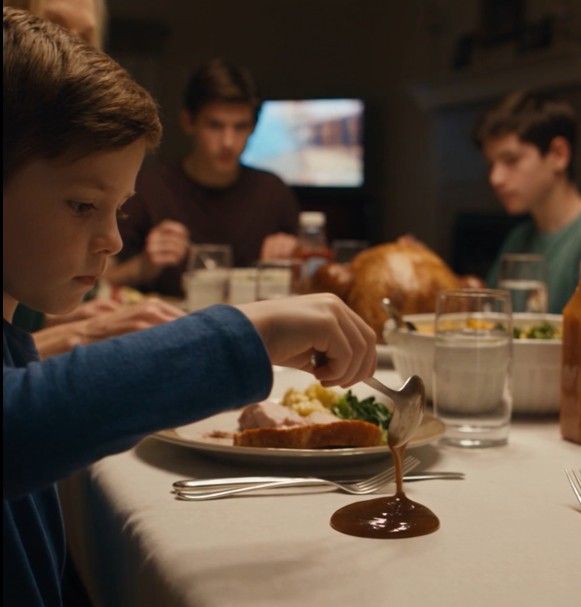
The older one—the cousin who had spoken at Thanksgiving—arrived carrying the wishbone in a plastic sandwich bag.
Jonah stared at it.
“I forgot to throw it away,” his cousin said. “Then I thought maybe I shouldn’t.”
He looked embarrassed.
“Why?” Jonah asked.
His cousin shrugged. “It was supposed to be yours too.”
Jonah had not known that.
At Thanksgiving, he had watched his cousin wave the wishbone above the table from the cabinet by the back door. He had assumed it belonged to the people seated at the table.
His cousin put the bag beside Jonah’s plate.
