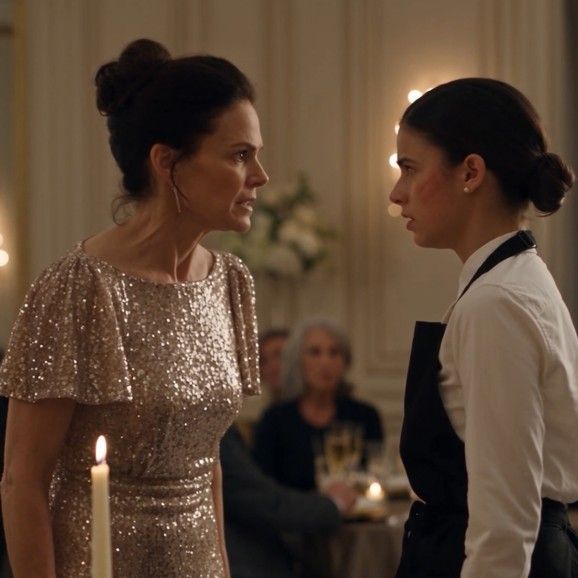
“My mother got me out,” she said. “Ruth got me through.”
Julian had spent much of his life thinking loyalty meant protecting the family from exposure.
He learned that loyalty could mean exposing what the family had done so the next person did not need fifteen years and a faded photograph to learn their own name.
Even Celeste changed how she entered rooms with Mara.
She never touched her without invitation. She never made a joke about the restaurant. When people who had heard rumors tried to turn Mara’s discovery into gossip, Celeste ended the conversation rather than speak for her.
Months later, Mara finally invited Celeste to coffee.
“I don’t forgive fast,” Mara said.
“You don’t owe me fast.”
Mara nodded.
It was not reconciliation in a single scene.
It was a door no longer being forced.
On the anniversary of the night everything changed, Mara returned to the restaurant as a guest.
There were no photographers.
No announcement.
Julian, Celeste, Ruth, and Bernard were there.
The manager had placed the old cream-blanket photograph in a simple archival sleeve beside Mara’s plate because she had asked to bring it.
Bernard sat at the piano.
He began Isabella’s melody.
Halfway through, he stopped.
Mara continued humming the next phrase.
Ruth joined her.
Julian closed his eyes.
For fifteen years, his family had treated silence as proof that a person could be gone.
Now the room was filled with a tune that had survived without a surname, a trust, or permission.
Mara looked at the photograph of the baby wrapped in cream and then at the people around the table.
“I spent my whole life thinking this picture was proof somebody abandoned me,” she said.
Ruth reached for her hand.
“What is it now?” Julian asked.
Mara listened as Bernard found the melody again.
“Proof that somebody made sure I got out.”
