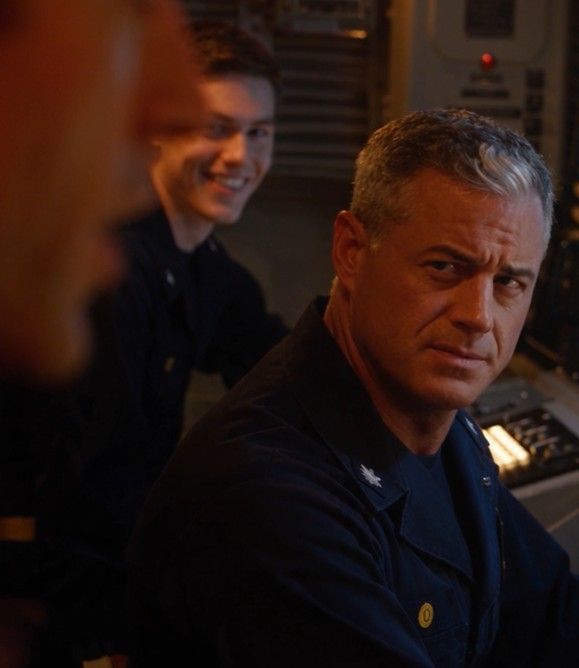
Evan did.
“Deep-submergence support vehicle,” he said. “Mercer mentioned it once. Experimental rescue platform attached to a joint training unit.”
“Why would it be here?” Hale asked.
Evan had no answer.
The secure message from higher command arrived three minutes later.
Hale read it, then read it again.
His face changed.
“Marlin was operating a classified recovery trial in a separate training area eleven days ago. It failed to return. Debris was recovered. Crew presumed dead.”
“Crew?” Evan asked.
“Mercer and Lieutenant Sofia Grant.”
The name meant nothing to Evan.
“What is it doing here?” Lawson asked.
“Apparently drifting.”
“Eleven days?”
Hale looked at the engineering estimates. “If they have been trapped that long, we can ask them after we get them out.”
That sentence gave the room a direction.
The submarine was not designed to recover a damaged small submersible directly. Getting close enough without collision required patience. A rescue buoy could not simply solve the problem at depth. Higher command began coordinating a specialized recovery asset, but it would take hours to arrive.
Mercer and Grant might not have hours.
The transmission returned, weaker.
“Power low. Air…”
The rest vanished.
Evan closed his eyes.
He remembered Mercer teaching diving candidates how panic wastes time.
“Your body will tell you every second is the last second,” Mercer had said. “Your job is to ask what is actually true.”
Evan opened his eyes.
“What is actually true?” he said.
Lawson looked at him.
“The contact is alive. We have comms. It is drifting. We can track it.”
Lawson nodded once. “Good.”
The crew established a repeating acoustic signal so Marlin’s occupants could orient toward the submarine without spending precious power on active systems. Hale authorized short communication windows instead of constant transmissions. Sonar tracked the small craft as it drifted along the submarine’s port side.
