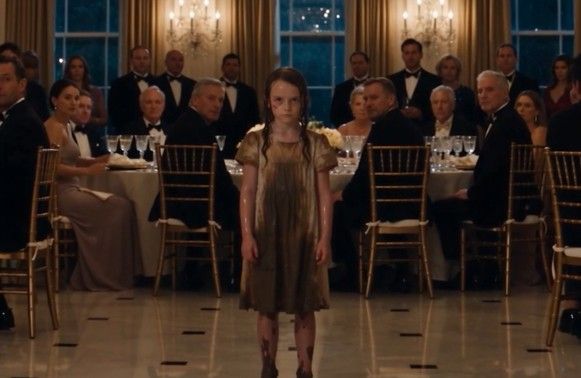
That admission ended any remaining ambiguity.
Lucy read none of the legal documents.
She was nine.
Her job was not to absorb the architecture of adult betrayal.
Her job was school, therapy, friends, and deciding whether she wanted vanilla or chocolate cake on her tenth birthday.
She chose both.
Before any permanent arrangement was approved, Henry had to learn how much of Lucy’s life had been built around adults deciding what she could bear.
He hated how familiar that pattern felt.
The first week after the ballroom, Lucy slept in a licensed emergency kinship home recommended by her social worker rather than in the Whitmore mansion. Henry had wanted to bring her home that night. His attorney, the social worker, and finally Lucy herself made him understand why that would have been another adult choosing speed over safety.
“I don’t know your house,” Lucy told him during their second supervised visit.
Henry almost said, It is your house too.
He stopped himself.
“Then we won’t call it home until you do,” he said.
Lucy studied him for a long moment, as if testing whether the promise had conditions hidden inside it.
Vanessa came to those visits without silver gowns or family assistants. The first time, she brought a backpack because Lucy’s school things had been lost in the confusion after Nora’s death. Vanessa had filled it with expensive supplies, then looked embarrassed when Lucy cared most about a plain blue notebook.
“Nora always bought blue,” Lucy said.
Vanessa removed the monogrammed leather journal she had included and put the blue notebook on top.
It was a small correction.
Henry noticed that Lucy noticed it.
He began making corrections of his own.
He ordered a complete review of every private account Evelyn had controlled during the previous fifteen years. The purpose was not to find a dramatic number. It was to reconstruct the choices that had kept Eleanor and Lucy outside his sight.
The records showed regular payments to Eleanor’s rehabilitation residence, Nora’s household, a private neurologist, and a law office that handled guardianship documents. None of the payments proved Evelyn had cared for them in the way she claimed. They proved she had known exactly where they were.
One invoice was particularly hard for Henry to read.
It was for Lucy’s fifth birthday.
The expense line said CHILD WELFARE SUPPORT and listed a cake, winter coat, and school shoes.
Henry sat alone in his study staring at it.
He had been at a foundation dinner that night, accepting an award for family philanthropy.
Across the state, his granddaughter had received a birthday cake through an account designed to keep her invisible to him.
Vanessa found him with the paper still in his hand.
“I keep thinking I should have known,” he said.
