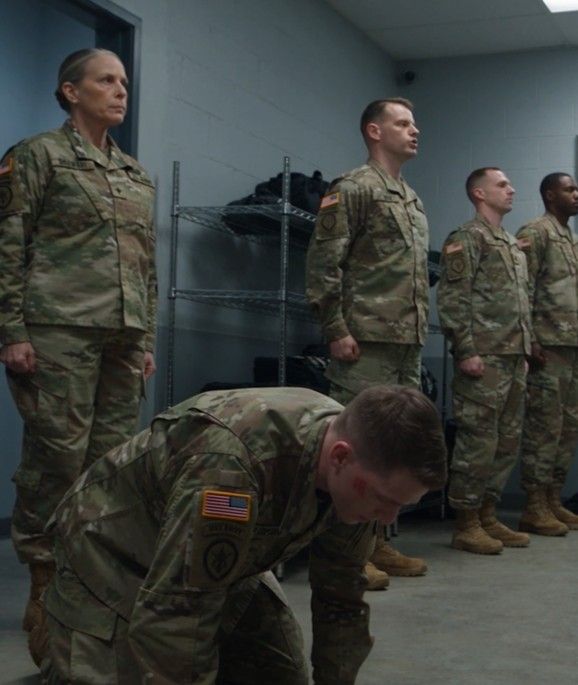
“I heard there was an issue with Sergeant Doyle.”
“There is.”
Voss’s eyes dropped to the notebook.
For less than a second, his face changed.
Recognition.
Then it was gone.
Evelyn had spent a career reading briefings, rooms, and people under pressure. She trusted the change.
“Do you know what this is?” she asked.
Voss smiled faintly. “No, ma’am.”
Dean made a tiny sound behind her.
Evelyn closed the door.
“Stay outside.”
Voss’s voice hardened. “Colonel, if this involves unit discipline—”
“It does. Stay outside.”
She locked the door again.
Dean looked at her as if he expected the lock to fail by authority alone.
“Tell me about Voss,” Evelyn said.
Dean shook his head.
“Private, I am not asking you to be brave for my benefit. I am asking for facts.”
His hands clenched against his knees.
“Sergeant Doyle runs the room,” he whispered. “Lieutenant Colonel Voss protects it.”
The sentence landed without drama.
That made it worse.
According to Dean, the room had existed in different forms for years. It was never on a training schedule. It had no official name. Soldiers were brought there for “correction” when certain NCOs believed formal counseling was too soft or too slow.
Sometimes the punishment was exhausting exercise.
Sometimes humiliation.
Sometimes striking.
The people involved called it tradition.
The people sent into the room learned not to call it anything.
“How do you know Voss protects it?” Evelyn asked.
