“I did.”
“The chain was the problem.”
“I know that now.”
He laughed bitterly. “That is convenient.”
Evelyn accepted the blow.
“Yes.”
Andrew looked toward the window. “Do you know why I left?”
“Because you would not keep participating in it.”
His eyes snapped back to her.
She had guessed correctly.
“I was told my next evaluation would recover if I stopped making noise,” he said. “Voss called me in and said I had leadership potential if I learned the difference between standards and sensitivity.”
Evelyn felt sick.
“What did you say?”
“I said if leadership required me to protect people who hit soldiers in locked rooms, I was not interested.”
Her eyes filled.
For four years she had believed her son left because something in him had failed.
He had left because something in him had held.
“I was proud of your career,” Andrew said. “I didn’t want to be the scandal attached to your name.”
“You were my son.”
“And you were a colonel who believed systems worked if people used them correctly.”
She looked down.
“I still believe systems can work.”
“Then build one that can hear someone when the system itself is the complaint.”
That became the sentence Evelyn carried into every reform that followed.
The investigation lasted four months.
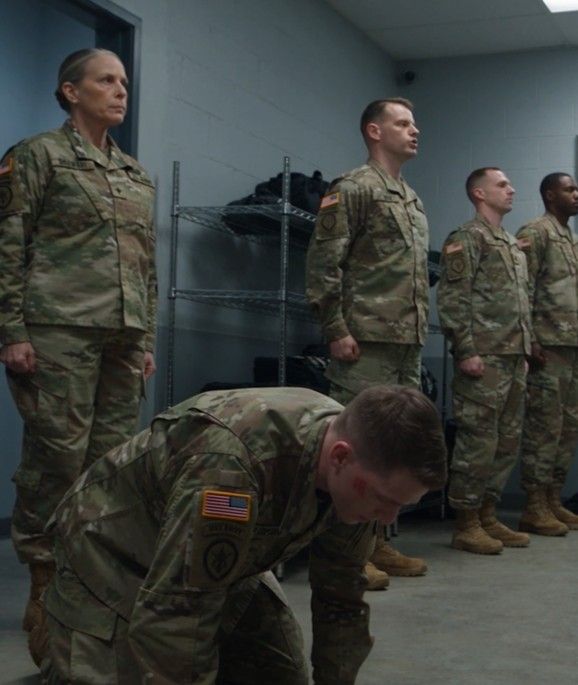
Sergeant Doyle’s denial collapsed as testimony accumulated. Several soldiers described being ordered into the room under the same language: standards, correction, tradition. Some had been struck. Others had been forced into degrading exercises or threatened with career consequences if they reported it.
Doyle claimed Voss never explicitly ordered violence.
That was true.
It did not save Voss.
Evidence showed he had been warned repeatedly, redirected complaints back into the same chain, discouraged external reporting, and approved adverse actions against some who complained. He had protected the practice by making sure no single document ever said what the room actually was.
