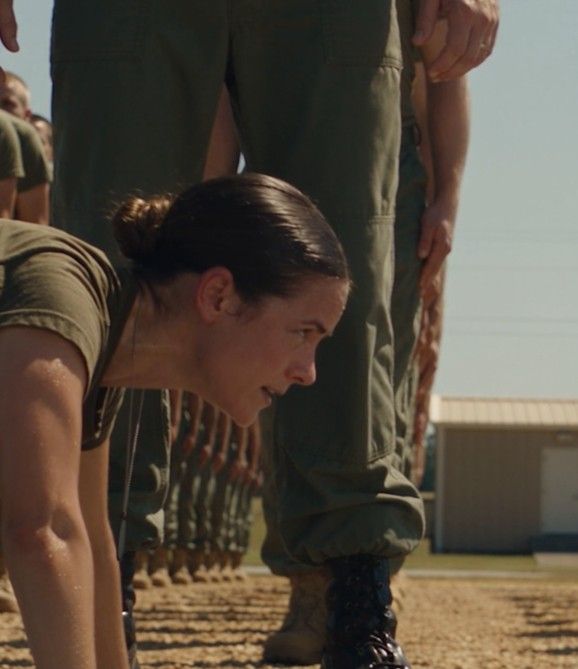
Hayes was removed from direct control of the platoon while the command reviewed the incident. A senior drill sergeant took over temporarily. The new instructor did not ask anyone to discuss what happened. He simply trained them.
That normality was unsettling.
No one was singled out.
Corrections were immediate, specific, and finite. A loose strap meant fix the strap, repeat the inspection, move on.
Sarah had not realized how much energy the platoon spent waiting for Hayes to choose a target until the waiting stopped.
The investigation uncovered more than the push-ups.
Several trainees described punishments that had stretched beyond correction into humiliation. One soldier had been forced to hold a loaded rucksack overhead after vomiting during a run. Another had been denied a water break after making a navigation error, though another instructor later corrected it. Sarah was not the first person Hayes had tried to break.
She was simply the first person the entire platoon had refused to watch alone.
The company commander interviewed Sarah last.
“Do you believe Drill Sergeant Hayes targeted you because you are a woman?”
Sarah considered the question carefully.
“I believe he expected me to fail because I am a woman.”
“Is that different?”
“Yes, sir. I can’t tell you what is in his head. I can tell you he watched me more closely, used different language with me, and gave me a punishment outside what we normally receive for a minor equipment issue.”
“Did he ever say women do not belong here?”
“No, sir.”
“Did he say things that implied it?”
“Yes, sir.”
She repeated them exactly.
No exaggeration.
No speech.
Facts were enough.
Hayes received formal disciplinary action for unsafe and unauthorized corrective training, was removed from trainee-facing duties, and was reassigned while the command reviewed his continued suitability as a drill sergeant. The investigation also found failures in supervision: other cadre had noticed his pattern and treated it as personality rather than risk.
That finding mattered to Sarah.
It was easy to make one man the entire problem.
Harder to admit a culture had given him room.
The company changed procedures. Extreme corrective training required explicit limits. Heat category restrictions were briefed before punishment as well as before scheduled physical training. Trainees were told how to report unsafe conditions without confusing legitimate hardship with abuse.
Some people hated the changes.
A few instructors muttered that basic training was becoming soft.
Sarah heard one comment while waiting outside supply.
