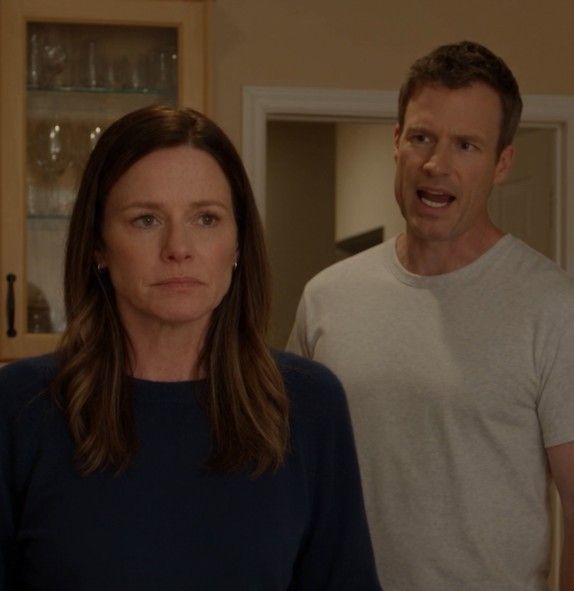
“This man had dinner in our house last night. You told me you barely knew him.” Claire’s husband stood in their kitchen, trying to make sense of something that had bothered him all evening.
The stranger had moved through the house with the ease of someone who knew it—not just where to sit, but where ordinary things belonged. Claire’s face tightened.
“He knew where our glasses were.” That detail had become impossible to explain away. Claire did not answer immediately.
For a long time, she had carried a private feeling that something in her life no longer fit together properly. Small pauses, altered explanations, missing pieces—none had seemed large enough on their own to justify the questions she kept suppressing.
Tonight, those details felt different. Her husband watched her.
He was no longer asking whether the stranger seemed familiar. He was asking why.
Claire could feel two possible futures opening in front of her. In one, she found another explanation and kept everything contained.
In the other, the silence ended here. Part of her still wanted the harmless version.
Wanting it did not make it true. Before Claire could answer, a voice came from outside the front door.
“Claire.” She went pale. Her husband saw it.
Whatever uncertainty had existed seconds earlier sharpened immediately. Claire did not move toward the door.
The man outside called her name again. The kitchen suddenly felt too still.
Her husband looked from Claire toward the entrance, then back at her, waiting for an explanation she seemed unable to give. Claire’s thoughts moved toward facts.
The stranger had been inside their house. He had eaten dinner there.
He knew where the glasses were. And now someone outside was calling for her.
None of those facts explained the whole situation. Claire refused to invent the missing pieces simply because fear made them feel connected.
But she could no longer pretend they were meaningless. “He found the list,” she whispered.
Her husband stared at her. “What list?” Claire did not answer.
The question hung between them. There had always been a cost to asking the wrong thing in the wrong moment.
Sometimes the cost was emotional. Sometimes it involved money, housing, or the quiet assumptions people made about what belonged to whom.
Claire had learned how easily ownership could become psychological before anything changed legally. If no one challenged an assumption long enough, someone could begin behaving as though a house, account, document, or future already belonged to them.
That was why details mattered now. Dates.
Amounts. Signatures.
Records. A list.
Her husband stepped closer, not touching her. “Claire.
What list?” She looked toward the front door. The person outside had gone silent.
That silence felt worse. Claire had spent too much time believing endurance meant strength.
Endurance had kept things functioning. It had also delayed questions she now understood should have been asked sooner.
She drew in a slow breath. The truth was not yet clear, but one thing was.
Someone outside knew enough to frighten her simply by calling her name. And someone had found something she had hoped would remain hidden.
