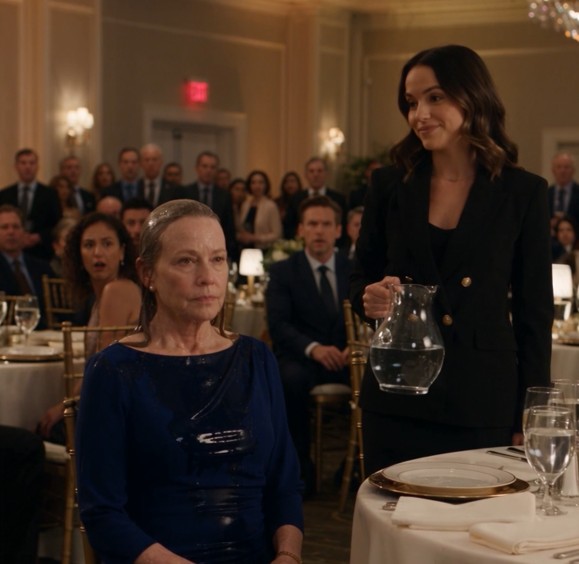
“Maybe now your ego will finally shrink.” Kendra tipped the glass pitcher before I could stand, and freezing water crashed over my head, shoulders, and navy dress. Ice cubes struck my lap and scattered across the ballroom carpet. Nearly two hundred conversations died at once. Kendra lowered the empty pitcher with a satisfied smile. Not embarrassed. Not shocked. Relieved. Water streamed from my hair and beneath my collar while everyone waited for me to react. Kendra expected tears. Anger. Maybe humiliation strong enough to make me leave my own retirement dinner. Instead, I pushed my chair back and stood. Her smile widened. I reached behind the chair, picked up the folded white linen towel resting there, and calmly placed it in her hand. “You may need this more than I do.” For one second, her expression disappeared. Then she laughed. “What is that supposed to mean?” I took a dinner napkin and wiped the water from my face. “You’ll figure it out.” My son Travis shoved his chair backward so quickly his glass shook. “Kendra, what are you doing?” She placed the empty pitcher on the table. “It was water.” “You humiliated Mom in front of everyone.” Kendra rolled her eyes. “That was the idea.” The silence deepened. Her husband, Grant, remained seated beside her, pale and rigid. “Kendra,” he murmured. She ignored him. Instead, she looked around the ballroom. “What?” Nobody answered. Retired executives, engineers, managers, and former colleagues stared at plates, coffee cups, and centerpieces. Kendra interpreted their discomfort as agreement. “See?” she said, turning back toward me. “They’re just too polite to say it.” I folded the damp napkin. “Say what?” She pointed toward the stage. Beside the podium stood a large photograph of me from my final year at Hawthorne Industrial Systems. “This,” she said. Her arm swept across the decorated ballroom. “This ridiculous production.” Travis frowned. “What are you talking about?” “The speeches. The photographs. The endless stories about how remarkable Loretta Vaughn supposedly is.” Several guests shifted. Grant covered his mouth with one hand. “Kendra,” he said again. “Don’t start.” He lowered his eyes immediately. That small reaction told me something. Whatever anger had brought Kendra to this moment had not begun tonight. “You couldn’t just retire quietly,” she said. “I asked for a small lunch.” She laughed. “Of course you did.” “I did.” “You expect everyone here to believe this company forced a ballroom on you?” I looked toward the stage. Howard Sutter stood near the curtain. He had led Hawthorne for twenty-one years and had known me through most of my career. Tonight, he was unusually still. “Yes,” I said. Kendra followed my gaze. Howard offered her nothing. No smile. No nod. No reassurance. She turned back toward me. “You always find a way to become important.” Travis stepped closer. “That’s enough.” Kendra lifted one hand without looking at him. “No.” Her eyes remained locked on mine. Water was still dripping from the hem of my dress, but I no longer felt embarrassed. I felt attentive. Because every sentence Kendra spoke was revealing something she had clearly wanted to say for a long time. She glanced toward the stage again. Then toward the people seated around us. “You all act like she built this place herself.” Nobody laughed. That seemed to irritate her. Howard finally moved away from the curtain. Only one step. But Grant saw it. His face changed. Kendra didn’t notice. She was still looking at me when Howard reached for the microphone beside the podium. And that was when I understood why several people in the room suddenly looked more nervous for Kendra than for me.👇
Howard’s hand closed around the microphone.
The soft pop from the speakers pulled every eye toward the stage.
Kendra turned.
For the first time since the water hit me, uncertainty replaced satisfaction on her face.
Howard did not look at her.
“Loretta,” he said, “I believe we should move part of the program forward.”
I wiped one last drop from my cheek with the damp napkin.
“Howard, you don’t have to.”
“I know.”
That mattered.
He stepped to the center of the stage.
“Ladies and gentlemen, there was supposed to be a ten-minute video before I said this.”
A few nervous laughs moved through the ballroom.
Howard glanced toward Kendra, then back at the room.
“But apparently timing has made its own decision tonight.”
Grant covered his face with one hand.
Kendra stared at him.
“What?” she demanded.
Grant whispered, “Please.”
She ignored him.
Howard continued. “Loretta asked for a small lunch. That part is true.”
I looked at Kendra.
Her jaw tightened.
“She asked us not to make her retirement into a production,” Howard said. “We declined.”
Laughter came more naturally this time.
“Not because Loretta needs attention. Anyone who worked with her knows she spent forty-one years avoiding it.”
My throat tightened.
Behind him, the large photograph beside the podium suddenly felt less like decoration and more like evidence of a life I had spent mostly looking away from cameras.
Howard clicked a remote.
The screen behind him changed.
An old black-and-white photograph appeared: Hawthorne’s original assembly plant in 1987. I stood near the back of a group of engineers, younger than Travis was now, my hair pulled into a severe ponytail, a clipboard pressed against my chest.
Howard smiled.
“When Loretta arrived at Hawthorne, we had fewer than three hundred employees. We also had a production problem that nearly cost us our largest customer.”
Kendra’s arms folded.
Howard described the failure rate in the old actuator line. He described the months our team spent tracing a defect no one could reproduce consistently. He described the test protocol I built after midnight shifts because the original process measured the wrong variable.
I wanted him to stop.
Not because any of it was false.
Because praise still made me feel exposed.
Then he said the sentence Kendra had mocked minutes earlier.
“Loretta did not build this company alone.”
Kendra gave a small triumphant nod.
Howard continued.
“But there are several moments when this company would not have remained standing without work she led.”
The nod disappeared.
He moved through the years.
The 1998 expansion.
The 2009 downturn.
The safety redesign after a near miss on Line Four.
The mentorship program I created when I realized young technicians were leaving because nobody showed them a path forward.
Nothing was exaggerated.
That was what made it powerful.
Howard named teams, not just me. Engineers. Operators. Supervisors. People in the room who lifted their glasses or nodded when their names were mentioned.
My career appeared the way I had always understood it: connected to other people.
Kendra had mistaken that connection for ego because she had only seen the evening, not the work.
Then Howard stopped.
“There is one thing Loretta does not know.”
I looked up.
Travis smiled through wet eyes.
Grant looked at the floor.
