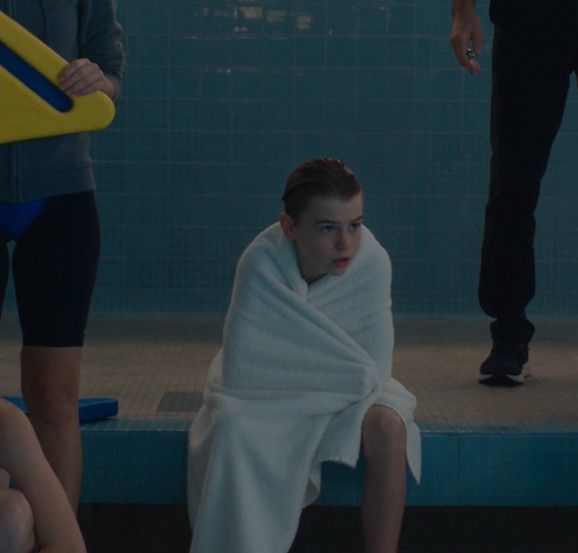
The coach blew his whistle directly beside the boy’s ear. “Again,” he shouted, although twelve-year-old Aaron was still trying to steady his breathing at the pool wall.
Water streamed from the boy’s chin onto the blue tiles. In lane six, every splash sounded separate and enormous, while his teammates waited on the benches with towels around their shoulders.
Aaron had missed the relay turn by less than a second. Coach Mercer called it laziness, the same word he used whenever Aaron asked for instructions to be repeated instead of barked across the water.
“Nobody goes home until he gets it right,” Mercer announced. The boys on the bench looked at Aaron, and the shame of keeping them there felt heavier than the wet swimsuit against his skin.
His father watched through the observation window upstairs. He could see the laps, the whistle, the circle of waiting children, but the thick glass turned the coach’s words into silence.
Earlier that month, Aaron had asked to leave the team. His father thought he was disappointed about losing a race and told him that confidence sometimes returned after difficult practice.
Now Aaron swam toward the far wall because he had been told to, counting the tiles beneath him. The pool had once been where his thoughts became quiet; lately it was where he practiced hiding them.
At the turn, he stopped. Assistant coach Mara stood at the lane rope, holding a kickboard she had forgotten to put away.
“Out of the water,” she said. Mercer shook his head from the other end, but she repeated the instruction to Aaron without looking back.
The boy climbed the ladder slowly. Nobody cheered, and he was grateful for that; being rescued in front of the team was already difficult enough.
Mercer crossed the deck. “You’re undermining me.” His voice had changed, no longer aimed at the children, but Aaron still curled his toes against the slippery tiles.
Mara handed him a towel. She had been on the staff for only six weeks, and the contract renewal form waited in her locker.
Upstairs, Aaron’s father saw his son sitting alone. He came down carrying the hoodie Aaron always wore home, puzzled by the practice ending without the usual team huddle.
“He quit on his teammates,” Mercer explained. Aaron lowered his head before his father could look at him.
Mara started to speak, but a boy on the bench interrupted her. “That’s not what happened.”
It was Dylan, the relay captain, whose younger brother was waiting in the lobby. He was usually the first to laugh when Mercer called Aaron soft, eager to stay on the safe side of the joke.
Now Dylan held his towel twisted between his hands. He looked at Aaron’s father, then at the coach, and swallowed hard enough that Aaron saw it from several feet away.
“We’ve been making him mess up,” Dylan said. “At practice. So he won’t get the relay spot.”
Mercer ordered him to stop talking. That was the moment Aaron’s father moved closer to the bench instead of closer to his son.
Mara remembered small things she had dismissed: changed starting orders, laughter near the lane boards, Aaron alone searching for a missing cap. She set the kickboard down against the wall.
Dylan glanced toward the younger children watching from the lobby door. “It wasn’t our idea,” he said, and the whistle in Mercer’s hand suddenly went still. 👇
Dylan looked at the whistle in Mercer’s hand.
Then he looked at Aaron.
“Coach told us to mess with his starts.”
Nobody moved.
Water slapped softly against the lane ropes. From the lobby, a vending machine hummed behind the younger children who had stopped pretending not to listen.
Mercer lowered the whistle.
“That is not what I said.”
Dylan’s face went pale, but he did not stop.
“You told us if Aaron couldn’t handle pressure, he shouldn’t have the relay spot. You said to make practice harder on him.”
Mercer laughed once. “Competition is supposed to be hard.”
Dylan twisted the towel tighter.
“You told Mason to give him the wrong count before the turn. You told me to move his cap. You said if he kept missing things, his dad would finally stop complaining about times.”
Aaron’s father looked at his son.
Aaron had never complained to him about times.
That was what made the sentence hurt.
He had complained about wanting to leave the team.
His father had translated that into disappointment about losing.
Now he understood how much he had filled in because the truth had seemed less likely than an ordinary sports problem.
Mercer pointed at Dylan. “You are trying to save yourself after admitting you sabotaged a teammate.”
Dylan flinched.
Mara stepped between the bench and the coach.
“He is admitting what he did,” she said. “You should let him finish.”
Mercer stared at her. “Your contract ends next month.”
Mara’s face changed.
Aaron saw it.
So did his father.
Mercer realized too late that the threat had been spoken in front of everyone.
Mara set the towel bag down.
“Yes,” she said. “It does.”
