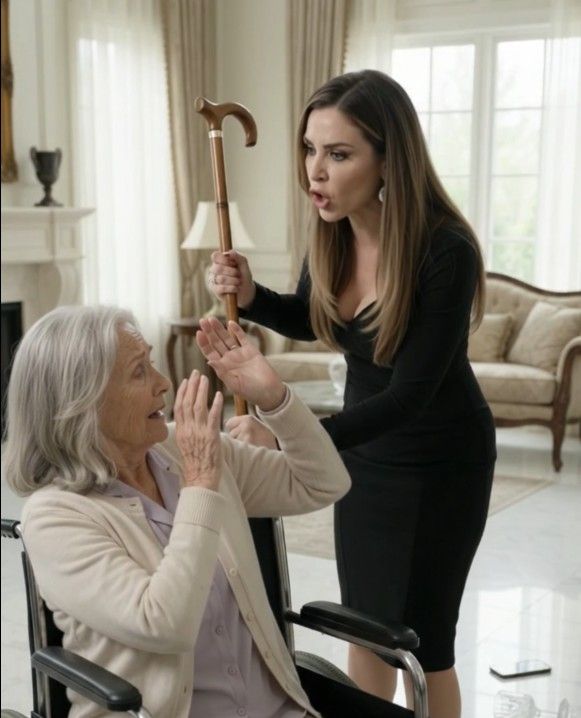
“The daughter-in-law thought she could beat her elderly mother-in-law into surrendering her mansion—but she never noticed the tiny silver pendant around the old woman’s neck.
“Sign the house over, or this gets worse!” the daughter-in-law screamed as she tore a wooden cane from her 70-year-old mother-in-law’s wheelchair and struck her across the shoulder. The elderly woman cried out, but her attacker showed no mercy. She slammed the cane against the wheelchair and shoved it so violently that it crashed into the coffee table, sending crystal glasses and family photographs shattering across the marble floor.
The mansion had once been filled with laughter, family dinners, and memories collected over a lifetime. Every room held something the elderly woman treasured, from photographs of her son growing up to the furniture she had chosen with such care. Now, the home she had spent decades building was becoming a place of terror, and the person threatening her was someone she had welcomed into the family.
All of it was happening because she refused to sign away her house. Her daughter-in-law wanted the property transferred into her own name and had grown more impatient with every refusal. She believed the older woman was too frail, too frightened, and too dependent on her wheelchair to stand against her. And with her husband away at work, she thought there would be no one to interfere.
She had waited until the mansion was quiet before confronting her mother-in-law again. At first, she demanded a signature, insisting that the house would belong to her sooner or later. But when the elderly woman refused, her anger turned into something far more dangerous. The wooden cane became a weapon, and the wheelchair offered its occupant no way to escape.
Desperate for help, the older woman reached toward her phone. Before her fingers could touch it, her daughter-in-law kicked it across the floor, far beyond her reach. Then she grabbed the wheelchair handles, dragged the chair backward, and raised the cane again. The old woman instinctively lifted one trembling arm to protect herself, yet she still refused to beg.
The cane hovered above her shoulder as she braced herself for another blow. The daughter-in-law leaned closer, convinced that fear would finally make her surrender the house. She was so focused on forcing that signature that she failed to hear anything beyond her own furious voice. And then the front door suddenly burst open.
Her son had returned home unexpectedly. For a fraction of a second, he stood frozen, staring at his wife holding a wooden cane over his defenseless mother. Then he rushed forward, seized his wife’s wrist, and tore the cane away before she could strike again. The shock on his face turned immediately into fury.
“You hit my mother?” he roared, his voice echoing through the enormous living room. He pushed his wife away from the wheelchair, and she stumbled backward into a display cabinet. Expensive decorations rattled against its glass shelves as she struggled to catch her balance. For the first time that afternoon, she looked genuinely frightened.
She had expected to control everything, including whatever story her husband heard when he came home. She could have called the broken glasses an accident and blamed his mother for starting an argument. But now he had seen her holding the cane himself, and there was no easy explanation for the scene before him. At least, that was what he thought.
Standing protectively between his wife and mother, the son turned toward the older woman. He saw her shaking hands, the battered wheelchair, and the family photographs scattered among pieces of broken glass. His expression softened with horror as he realized this might not have been the first time she had suffered in silence.
“Mom… how long has this been happening?” he asked. His mother didn’t answer immediately, and the room grew painfully quiet. Instead, she reached beneath her cardigan and slowly pulled out a small silver pendant hanging around her neck. A tiny light blinked on its surface.
The daughter-in-law’s expression changed the instant she saw it. Her arrogance disappeared, her lips parted, and her eyes widened as she stared at the device she had completely overlooked. The elderly woman looked straight at her, strangely calm despite the pain in her shoulder, and finally spoke.
“I pressed this before you picked up the stick.” Her son stared at the pendant, struggling to understand what those words meant. But his wife understood immediately—and the color drained from her face. Suddenly, she wasn’t thinking about the house or the signature anymore. She was thinking about who might already have heard every threat, every scream, and every sickening blow.
A faint voice emerged from the pendant before anyone in the room could speak. “Ma’am, help is on the way. Are you able to tell me whether you’re safe now?” The son turned toward the small silver light as if he had never seen it before. His mother swallowed and said someone had taken the cane away, but she was still frightened. He knelt beside her wheelchair, careful not to touch the shoulder that had been struck. His wife backed toward the broken photographs on the floor. For the first time since the attack began, the older woman did not have to carry the truth by herself.
“My name is Eleanor,” she told the operator. Her voice trembled, but the words were clear. “My daughter-in-law hurt me because I would not give her my house.” The operator asked where everyone was standing and instructed them to remain apart while emergency responders approached. Eleanor’s son, Nathan, moved the cane well out of reach and told his wife to sit down. She shouted that he was choosing his mother over his marriage. Nathan looked at the bruising already rising beneath Eleanor’s cardigan. “I’m choosing to stop you from hurting her again,” he said. His voice was quiet, and that seemed to frighten his wife more than his earlier anger.
The daughter-in-law, Lydia, said the pendant was a trick. She claimed Eleanor had provoked her, exaggerated the shove, and deliberately smashed the glasses to make her look cruel. Nathan turned toward the coffee table, its edge scraped by the wheelchair, and the family photographs scattered among sharp pieces of crystal. He had watched Lydia lift the cane. He could no longer tell himself that a domestic argument had somehow become an accident. Eleanor reached toward him with her uninjured hand. “Please don’t argue,” she whispered. “Just stay where I can see you.” He sat on the floor beside her chair and kept his eyes on the front door.
The responders arrived through the entrance that had always opened onto family dinners and holiday visits. A paramedic checked Eleanor’s breathing, pulse, and shoulder while another assessed whether she had other injuries. Police officers separated the accounts and took photographs of the damaged room. Lydia insisted that the house was essentially hers because she and Nathan would inherit it. One officer asked for the ownership documents, not her expectations. Eleanor said she could provide them after receiving medical care. No one asked her to surrender the property to make the situation simpler. She felt the first delicate movement of relief beneath the pain.
Nathan rode with his mother to the hospital. Lydia remained at the house while officers completed their initial work and discussed the next steps. As the ambulance doors closed, Eleanor looked through the window at the stone steps she had climbed for decades. The mansion had seemed enormous that morning, all polished floors and locked rooms where her voice could disappear. Now she was leaving it because she had asked for help, and she was terrified of what would happen when she returned. Nathan took her hand. “I should have seen this,” he said. She closed her eyes. She needed him to understand, but she was too tired to comfort him yet.
At the hospital, imaging ruled out a major fracture, but the doctor documented bruising, swelling, and injury to the soft tissue around Eleanor’s shoulder. She had pain in her wrist as well, and the nurse noted the fear that rose whenever someone reached abruptly toward her wheelchair. Eleanor was offered information about elder-abuse services, protective orders, and safe arrangements for her return home. She had spent so many years being the person others depended on that accepting assistance felt almost shameful. The nurse noticed her hesitation and asked what she wanted most. “I want to sleep without listening for footsteps,” Eleanor answered.
The words undid Nathan. He turned away and covered his face. For months he had been proud of how efficiently Lydia helped manage the household while he worked long hours. He had accepted her explanations when Eleanor grew quiet during visits or refused to be left alone with his wife. He had called it tension between two strong personalities. Now he understood that his mother’s silence had been a survival strategy. He told the nurse that he wanted Eleanor to stay with him until they could secure the mansion. Eleanor shook her head. “I don’t want to be moved somewhere else again because she frightened me,” she said. “I want my own home made safe.”
They worked with a victim advocate and Eleanor’s attorney, whom Nathan contacted at her request. Eleanor was careful to make her own decisions. She asked for lawful protection from Lydia, for access to her belongings, and for a plan that would let her return without putting herself at risk. The advocate explained options without promising that paperwork alone could guarantee safety. Nathan arranged for a trusted family friend to stay with Eleanor when she wanted company and hired professionals to assess the home’s security after consulting her. He also provided his eyewitness account to investigators. It was the first practical help he had given her that did not require taking control.
The monitored pendant became an important part of the evidence. The alert service had logged Eleanor’s call and the operator’s contemporaneous observations. Investigators sought any preserved audio through the proper process and considered it alongside medical records, photographs, statements, and the physical damage. The recording alone would not answer every question, and Eleanor’s lawyer warned against treating a device like a magical witness. But it established that Eleanor had asked for help before Nathan arrived and that her fear was not invented after the confrontation. Lydia’s claim that the entire scene had been staged became harder to sustain each time another independent detail was checked.
A detective later asked Eleanor whether she had experienced earlier threats. At first she said this had been the worst incident. The detective waited, giving her time. Eleanor remembered Lydia locking her medication in a kitchen cabinet “for safekeeping,” then insisting that she ask permission to access it. She remembered conversations about the deed that began as jokes and ended with Lydia shouting that old people should not hold valuable property. She remembered a bruise she had concealed beneath a shawl after Lydia gripped her arm during an argument. Telling the truth aloud made her feel sick. She had been measuring each episode against the possibility of something worse and persuading herself she could manage it.
Nathan listened to these details in a separate conversation with Eleanor’s permission. He had not known about the medication, but he remembered Lydia telling him his mother had become stubborn and difficult. He remembered dismissing a complaint about missing papers because he thought Eleanor had misplaced them. At home that evening he opened the cabinet where Lydia had stored property documents. He found folders labeled with the mansion’s address and a checklist of tasks required for a transfer. Some items were crossed out. Others included notes about obtaining a signature and arranging a meeting without an independent adviser present. He photographed the papers, did not alter them, and contacted the attorney about how to preserve them properly.
Lydia called Nathan from another number and begged him to withdraw his statement. She said a conviction would ruin her life. She claimed she had lost her temper because she was worried about their future and the expense of caring for his mother. Nathan told her that Eleanor owned the house and had never promised it to either of them. Lydia answered that everyone knew it would be theirs eventually. He felt the old temptation to smooth things over, to call this a terrible mistake and persuade everyone to move forward. Then he remembered his mother’s voice asking to sleep without fear. He told Lydia to communicate through counsel and ended the call.
Eleanor returned home with support in place and an appropriate protective order as the legal process continued. The mansion looked different when she crossed the threshold. The broken crystal had been removed, but pale squares remained on the marble where framed photographs had stood. Her wheelchair rolled past the place where she had been struck. She gripped the armrest until the advocate asked whether she wanted to stop. Eleanor said yes. For several minutes they stood in silence while she caught her breath. Then she asked Nathan to bring a cloth and a bowl of warm water. She wanted to clean the table herself, a little at a time.
He offered to do it for her. She refused, gently. “I need to know these hands still belong to me,” she said. He knelt and steadied the bowl while she wiped dust from the wood. They worked in small movements, careful of her healing shoulder. When the table was clean, Nathan brought out the framed photograph of Eleanor and his father on the day they bought the property. The glass had cracked in the attack, but the photograph was undamaged. Eleanor touched the edge of the image. Her husband, Samuel, had died several years earlier. She had kept the mansion because it held the life they had built, not because she believed stone walls were more important than people.
The weeks that followed were neither peaceful nor simple. Eleanor woke at night convinced she had heard Lydia in the hallway. She began trauma-informed counseling and worked with a physical therapist to regain comfortable movement in her injured shoulder. Some days she was furious at everyone; other days she apologized for needing help. Nathan learned not to demand reassurance that she was recovering quickly. He asked whether she wanted company, brought food when invited, and left when she needed quiet. The work of being trustworthy consisted mostly of doing what he said he would do, without turning his mother’s home into a place he managed by default.
A formal investigation uncovered messages in which Lydia demanded that Nathan persuade his mother to sign the property over. Some of the messages were old and bitter; others were chillingly specific about making Eleanor feel dependent. The documents showed intent, while the medical records and eyewitness accounts established the violence. Lydia, represented by an attorney, contested portions of the allegations but could not make the evidence disappear. As the case progressed, she lost the access and influence she had once assumed would give her the house. Nathan began divorce proceedings after careful consideration and sought advice about separating their finances. He refused to bargain with Eleanor’s safety to preserve the appearance of a marriage.
