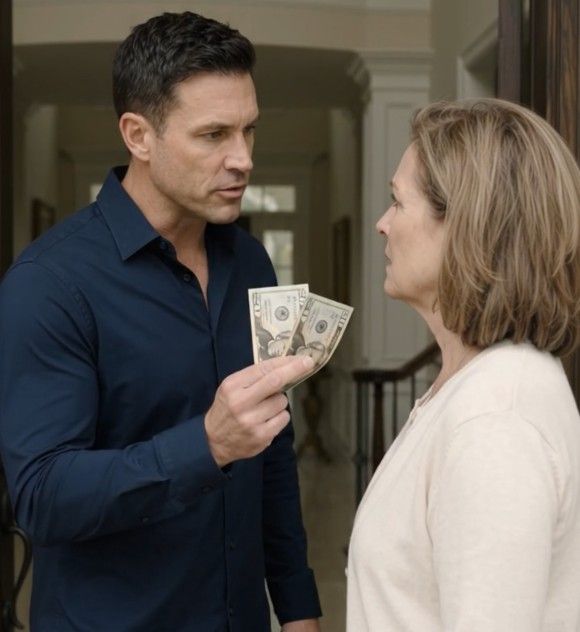
My own son froze every bank account I had, leaving me unable to buy groceries. Then he pulled two twenty-dollar bills from his wallet.
“Here. For groceries. Don’t spend it all in one place.”
I was sixty-eight, standing outside the house of the child I had raised, while his wife, Karen, watched with a smile. Five years after my husband Warren’s death, our son had decided that helping us build a business worth $42 million entitled him to decide whether I could buy chicken and tomatoes.
My name is Mrs. Morrison. Warren started as a mechanic, working twelve-hour shifts with grease beneath his fingernails. Together, we built Morrison Auto Group: twelve dealerships in three states. He knew engines. I knew how to make a payroll clear when two customers were late and the roof needed replacing. We had learned the rest together.
That morning at Whole Foods, my credit card was declined. Then my debit card. Then my emergency American Express, which had never failed me before. I left the groceries behind and called the bank from my car.
“Your accounts have been frozen,” the representative said. “Someone with authorized access reported a concern.”
I thought immediately of Desmond, my only son. I had given him power of attorney after surgery because I trusted him to handle the bills while I recovered. I drove to his house, where Karen opened the door and said he had blocked the accounts because it was time I learned boundaries.
Desmond appeared behind her.
“Yes, Mom. I froze everything.”
“After everything your father and I built?”
“Someone has to protect the family fortune.”
“From whom?”
“From you.”
Then he told me that he and Karen intended to sell the dealerships. He claimed I had signed documents authorizing changes while recovering from surgery. Documents I couldn’t remember signing. They planned to remove me from the accounts and the decisions tied to the company Warren and I had built.
“You can’t do this,” I whispered.
“Actually, Mom, we already have.”
He offered the forty dollars. I refused to touch it. My phone rang before he could put the bills away.
“Mrs. Morrison? This is Frederick Peyton from First National Bank. Unusual transactions have triggered a security provision you and Warren established. Are you somewhere you can speak privately?”
I looked at Desmond, still smiling in the doorway.
“Mr. Peyton, what exactly did my husband arrange?”
The banker took a breath. “What I’m about to tell you changes everything.”
I walked to my car and locked the doors. Before discussing anything further, I told him I would call the bank through its published number. He said that was the right thing to do and gave me his extension. Even then, I could hear Warren reminding me that urgency was no reason to skip a simple precaution.
When I reached Peyton again, he asked whether I had approved a transfer from the founder reserve and a change to its controlling authority. I said no.
“The request arrived with documents presented by your son,” he said. “The reserve has an additional verification requirement. We need direct confirmation from you unless the separate succession conditions have been satisfied.”
“What conditions?”
“I can send you the relevant documents securely and arrange a meeting with your counsel. The bank has not accepted the attempted change. The funds affected by that request remain here.”
I closed my eyes. The family fortune, which Desmond had described as if it were already packed into his car, had encountered a door he didn’t know how to open.
Years earlier, after a friend’s son had emptied an account during his father’s illness, Warren and I had reviewed our arrangements. We had kept a reserve outside routine operating authority and required independent confirmation before anyone changed control or moved substantial funds from it. Our lawyers had coordinated that with the trust holding the controlling interest in the business. I remembered signing the documents. I had forgotten how carefully we had planned for exactly the person we would never want to fear.
“Warren didn’t create a new fortune you knew nothing about,” Peyton said. “You both put safeguards around what you already owned.”
That distinction steadied me. I wasn’t waiting to be rescued by a secret my husband had left. I needed to use a protection we had chosen together.
