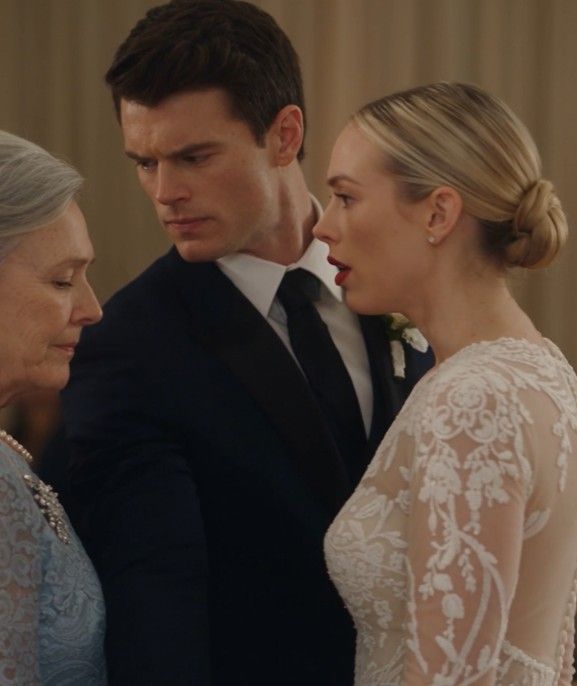
“She makes the picture look cheap,” my new daughter-in-law said as the photographer raised his camera. Three feet away, my son was reaching for me.
I am Grace Carter, seventy-seven years old, and that afternoon I wore a pale blue dress, comfortable shoes, and pearl earrings that had belonged to my mother. I had saved for the dress because Noah had specifically asked me to stand beside him in his wedding photographs.
Brittany stood between us in an expensive white gown. Behind her, ivory flowers rose on glass pedestals. The ballroom was prepared for three hundred guests, and every polished detail looked ready for a magazine spread.
“We don’t need her in this one,” Brittany told the photographer.
“That’s my mother,” Noah replied.
Brittany kept smiling. “Exactly. But she makes everything look cheap.”
I felt a hot flush climb my neck. Noah’s outstretched hand remained between us. I could have taken it. Instead I stepped back, because mothers become very good at trying to make difficult moments easier for their children.
“It’s all right,” I said. “Take your picture.”
“It isn’t all right,” Noah answered.
I turned toward the edge of the raised platform. Then Brittany caught my arm.
“Get out of the frame,” she hissed.
Her grip tightened. My heel found empty space, and suddenly the platform seemed to slide away beneath me. My hip struck the boards. Pain shot through my wrist. Someone gasped, and the photographer lowered his camera.
Noah reached me before anyone else. He knelt, one hand supporting my shoulder.
“Mom, look at me. Are you hurt?”
“My wrist,” I admitted. “I think I landed badly.”
His expression changed when he looked at Brittany. She said I had stumbled. Then she said she had barely touched me. Her mother arrived to insist that everyone should discuss it privately because guests were recording.
Noah looked from my bruising arm to his bride. Without a word, he removed the boutonniere from his lapel and set it on the platform. The string quartet had stopped. Through the ballroom doors, I could see guests waiting for a reception that no longer seemed certain.
A nurse in the crowd gently checked my fingers. I could still move them, although it hurt. Noah refused to leave my side.
Then the photographer approached, camera held against his chest.
“Mrs. Carter,” he said quietly, “I took a picture just before you fell. When Noah reached for you.”
“Please keep it,” I said. “That was a good moment.”
He glanced toward Brittany, then turned the screen so only Noah and I could see it. In the photograph my son’s hand reached toward mine. Reflected behind him, in a narrow mirrored panel, was something none of us had noticed at the time.
The photographer swallowed. “I think you should look at what she was doing with her other hand.”
I leaned toward the camera screen, my wrist cradled against my chest. The photograph showed Noah facing me, his hand extended, his mouth just beginning to form my name. Brittany stood between us with a smile that looked pleasant until you noticed the mirrored column behind her. In the reflection her right hand was closed around the fabric at my upper arm. She had been gripping me even while she told everyone she hadn’t touched me. I stared at the tiny image until the pain in my wrist became the least confusing thing about that afternoon.
“Can you save the original?” Noah asked the photographer. His voice was controlled, which worried me more than if he had shouted. The man nodded. He introduced himself as Evan and explained that the camera recorded the image as an original file, with a sequence showing what happened immediately afterward. He could preserve the images and provide copies through the proper channels. Noah thanked him. Brittany approached us with her mother close behind and asked why we were examining a camera when three hundred people were waiting for dinner.
I looked at Brittany. Until that morning I had hoped that the distance between us was only unfamiliarity. She liked elegant things and I liked comfortable shoes. She spoke in polished sentences and I sometimes lost my train of thought. Differences like those are not crimes. But I had now heard her call me cheap and felt her fingers push me off a platform. Still, I waited for her to say she was sorry. Her first words were, “You’re making an unfortunate accident look deliberate.” She did not ask about my wrist.
Noah stepped between us. “She needs to be examined properly.” The nurse who had checked me, a guest named Clara, agreed. She explained that I should not ignore a wrist injury simply because I could move my fingers. Noah arranged a ride to an urgent-care clinic rather than trusting my insistence that a little ice would solve everything. Brittany’s mother called after him that the reception contract was nonrefundable. He turned around. “Then the money is gone,” he said. “I’m not leaving my mother hurt on the floor to save a dinner.”
The drive was quiet except for the ticking of the signal lights. Noah held my handbag because fastening the strap hurt. I watched his reflection in the passenger window, still dressed in a tuxedo with a pale square where his boutonniere had been. I wanted to tell him that he could return and salvage the day. I began the sentence twice. Both times I stopped because I could hear the old reflex underneath it: make yourself smaller so other people can go on celebrating. For once the decision belonged to him, not to my fear of being inconvenient.
At the clinic the physician ordered imaging. Nothing was broken, but the wrist was badly sprained and my hip was bruised. I was given a supportive splint, instructions for rest, and advice about warning signs that would require further evaluation. The mundane precision of the treatment steadied me. A body could be hurt without requiring an argument about whether it had been hurt. The nurse documented what I reported about the fall without pretending she had witnessed it. Noah helped me into my coat while my hands shook from pain and delayed adrenaline.
Back in the parking lot he asked whether I wanted to contact the police. I had never expected to consider that question on my son’s wedding day. I asked first whether he was sure about ending the celebration. Noah looked straight at me. “Mom, she pushed you and lied while you were on the ground. Those are her choices. Not yours.” He explained that he had not yet decided every legal or practical consequence. The wedding ceremony had taken place, and paperwork could not be undone with a ring removed in anger. But the party, he said, was over.
