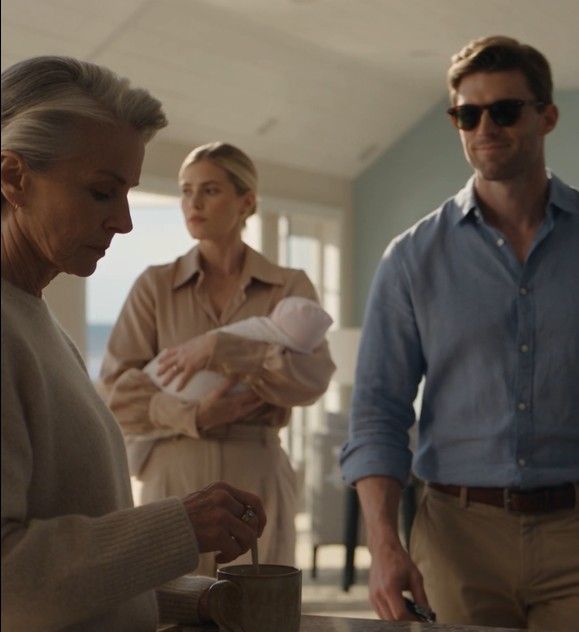
The keys hit my marble side table with a small, confident clink.
My son Preston had entered my new villa without knocking. Now he was telling his wife, Kendra, which bedrooms they would occupy while I stood in the living room holding a cup of coffee.
“We’ll take the main house,” he said. “You can live in the guesthouse. It’s perfect.”
He smiled up at the vaulted ceiling like he had just found something he’d been owed all along.
Three weeks earlier, Preston had barely wanted to visit me. At sixty-one, divorced after thirty-four years of marriage, I had been renting a one-bedroom apartment behind a laundromat in Sarasota. When I complained about the brick wall outside my window, he told me to be realistic. Kendra said renting was fine “for some people.”
They didn’t know I had sold two modest properties left to me by my grandmother and purchased this white Mediterranean villa near the bay. For three weeks, I kept the news to myself. I unpacked my grandmother’s china and painted one wall pale blue simply because I loved the color.
Then a neighbor posted photographs from my housewarming dinner.
By Saturday morning Preston’s black SUV was at my gate. Kendra carried their baby, Lila, on her hip. She studied the arched doorways and spacious kitchen as though calculating where to place her belongings.
“Our lease is ending,” Preston explained. “Paying rent is throwing money away. You should be glad we’ll be close.”
I stared at the car keys he had left beside my cup. “No.”
His eyebrows lifted. I had spent years making his life easier, and the word sounded unfamiliar to us both.
Kendra tightened her grip on Lila. “You would rather have your granddaughter grow up in a cramped apartment while all this space sits empty?”
I looked at the baby, her tiny hand tangled in her mother’s dress. I loved Lila with my whole heart. That did not make her parents owners of my home.
“I would rather she learn that someone else’s house isn’t a prize,” I said.
Preston’s cheeks reddened. “You think you’re powerful because you bought a fancy house?”
“No,” I answered. “I think I’m home.”
His phone buzzed. Preston read the screen, then slipped it into his pocket so quickly that the movement was almost clumsy.
Kendra saw it. The two of them exchanged a look, and for the first time they seemed afraid of the same thing.
I recognized that expression. Preston’s father used to wear it just before another bill or broken promise surfaced. I reached toward the keys, intending to return them.
But the phone vibrated again, lighting up through the thin fabric of Preston’s pocket. The caller’s name was visible for an instant—and I knew exactly why he needed my house.
The name was not a person’s. It was the word LANDLORD, spelled in capital letters, followed by three missed calls.
Preston’s hand closed over the pocket. Kendra took one step toward him, then stopped when she saw that I had noticed. Lila made a sleepy noise against her mother’s shoulder. In the hush that followed, the ceiling fan seemed suddenly loud.
“Your landlord has been trying to reach you,” I said.
“It isn’t what you think.” Preston’s reply came too fast. He lifted his keys from the table and rolled them along his knuckles, a childhood habit that appeared whenever he was cornered.
“Then tell me what it is.”
Kendra kissed the baby’s forehead. “We shouldn’t do this in front of Lila.”
“She doesn’t understand any of it,” I said. “But eventually she will understand how people behave when they don’t get what they want.” I opened the kitchen door to the shaded terrace, where an outdoor chair waited beneath a flowering bougainvillea. “Let’s sit down and talk.”
Preston didn’t move. He stared at the wide staircase, then at the corridor leading to the guesthouse. He was deciding how much honesty would still leave him with the largest bedroom.
I remembered his first bicycle, when he was six. He had ridden into a hedge, broken the training wheel, then insisted the pavement had moved. I had once found that stubbornness charming. Now it had grown expensive.
Finally he said, “We’re behind on rent.”
