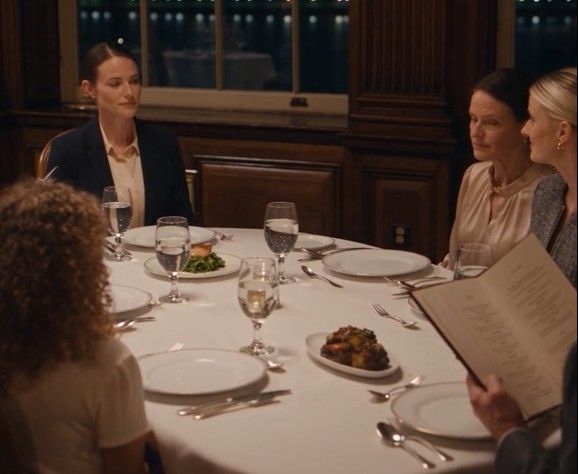
“Can you really afford a place like this?” Melody’s question rose above the soft clinking of silverware, and she made no attempt to keep her voice down. A few people at nearby tables glanced over, then quickly looked away, while I kept my hands folded beneath the edge of the white tablecloth.
Across from me, Melody leaned back in her chair with a small, satisfied smile. The restaurant sat on the top floor of a historic hotel overlooking the Potomac, tall windows framing the lights of Washington across the water, crystal fixtures glowing above dark wood and polished brass.
Everything about the room spoke of wealth, and Melody seemed determined to prove she belonged. She had spent most of dinner admiring the wine list, the hand-painted plates, the deputy secretary at another table, and then her attention shifted back to me.
Her eyes rested on my blazer—black, plain, seven years old, the fabric near one cuff softened, the elbows tidy but no longer sharp. I had paired it with a simple cream blouse and dark trousers, and there was nothing noticeable about my outfit, which seemed to make Melody happy as she brushed her fingers over her own new jacket and mentioned its designer label twice.
“You heard what I said, Claire.” I met her gaze. “I heard you.” Her smile widened. Our mother, Diane, shifted uncomfortably, and my father, Robert, kept his eyes on the menu, neither one stepping in.
Melody tilted her head. “Well?” “So what?” “So, can you?” A quiet laugh slipped from our cousin Daniel, disguised with a cough. I reached for my water; the glass was cool beneath my fingers. “I’m already sitting here.” “That’s not what I asked.” I took a slow drink.
Melody looked around the table. “Come on. Isn’t anyone else wondering?” “Melody,” our mother warned. “What? You don’t need to make everything a competition.” “I’m not competing.” Melody kept her eyes on me. “That would require there to be some competition.” Daniel laughed again, this time not hiding it, and my father finally looked up. “That’s enough.” Melody raised both hands. “I’m kidding.” There was not even a trace of apology in her voice.
The waiter arrived with our appetizers, placing my salad down last. “Thank you,” I said, and he gave me a short nod. “Of course, ma’am.” Then he walked away, and Melody noticed the brief exchange. “You’re awfully polite tonight.” I looked at her. “Should I apologize for that?” Daniel smiled into his glass, and Melody pierced a roasted beet with her fork. “I’m just surprised you’re comfortable in a place like this.”
There it was again—not curiosity, but positioning. She wanted everyone at the table to know exactly where she believed I belonged. Our family had always treated success as though everyone had been given an assigned seat: Melody’s achievements were announced proudly, mine were reduced to a few brief words, her promotions became excuses for family celebrations, and my absences were treated as inconveniences. For years, it had been easier to let that arrangement continue.
Tonight was supposed to be different—our parents’ thirty-fifth wedding anniversary. Melody had chosen the restaurant, or at least that was what everyone else believed. She had shared photos in the family group chat, praised the private dining room, reminded everyone that jackets were preferred, then added one final message aimed directly at me: “Try to look presentable.” I never responded.
Now Melody studied my blazer as though she had discovered evidence. “How old is that thing?” My mother closed her eyes. “Melody.” “I’m just asking.” “Seven years,” I said. Melody blinked. “You actually admit that?” “It’s a jacket.” “It’s basically an antique.” My father cut into his scallop. “It looks perfectly fine.” She turned to him. “Dad, you’d say that about a garbage bag.” “That depends on the garbage bag.” Daniel laughed, and even I nearly smiled, but Melody didn’t—she hated losing control of the moment.
Then she leaned forward, lowering her voice just enough to make everyone lean in. “You won’t believe what happened next.” The table went quiet. My mother looked at me, my father set down his fork, Daniel stopped smiling, and Melody just waited, because she knew something about this restaurant, something about why I was really there. And the moment she said it, I realized the dinner had never been about our parents’ anniversary at all.
Melody reached into her purse and pulled out a folded piece of paper, smoothing it open on the table like a prosecutor presenting evidence. It was a photograph of me standing outside the Carrington Building downtown, a glass-and-steel tower where Archer Capital occupied the entire top floor, and she tapped the image with one manicured nail as if she had just solved a crime.
“I saw you there last week,” she said, her voice carrying just enough for the next table to hear. “I was having lunch with a client, and I looked across the street, and there you were—plain jacket, plain shoes, plain everything—walking into the most expensive building in the city like you owned it. So I asked around. I have a friend whose firm leases space on the tenth floor. She said the top floor belongs to Archer Capital. She said the CEO is never there. She said no one has ever met her.”
Daniel frowned. “Her?” Melody nodded, her smile sharpening. “Her.” She looked at me, and the satisfaction in her eyes was almost physical. “You’re the CEO of Archer Capital. Aren’t you, Claire?”
The table went silent. My father stared at me, my mother’s mouth opened, and Daniel looked genuinely confused. I set down my water glass, folded my hands on the table, and met Melody’s gaze without blinking. “Yes.”
Melody’s smile faltered for just a moment before it returned, wider and more vicious. “So you’re rich. So what? That doesn’t mean you belong here. It doesn’t mean you get to sit at this table and pretend you’re one of us. You’ve been lying to us for years. You’ve been hiding. You’ve been pretending to be poor and making us feel sorry for you.”
“I never asked anyone to feel sorry for me,” I said quietly. “You never corrected us either,” she shot back. “You never asked,” I replied, and Daniel flinched as if the words had been aimed at him.
Melody stood up so fast her chair scraped against the floor. “I’m done. I’m not going to sit here and be lectured by someone who thinks she’s better than everyone.” “I don’t think I’m better than anyone,” I said. “You do. You always have. You’ve always been the smart one. The quiet one. The one who never needed anyone. The one who disappeared.”
“I didn’t disappear. I moved away. I built a life. I built a company.” “And you didn’t tell us.” “Because you never asked.” Melody’s eyes were wet, her face red, and she turned to our parents. “Are you going to say something?”
My mother looked at me, her voice trembling. “Claire, is it true? Are you really the CEO of a company?” “Yes.” “Why didn’t you tell us?” “Because you never asked.”
My father set down his napkin and stood. He walked around the table and stood beside me, and for the first time all night, his voice was steady. “I’m proud of you.” Melody’s face crumpled. “Dad—” “No. I’ve listened to you mock your sister all night. I’ve watched you try to humiliate her. And I’ve said nothing. I should have said something sooner. I should have said something years ago.” He looked at Melody. “You are my daughter. I love you. But you are not kind. And I am tired of pretending that you are.”
Melody burst into tears, grabbed her purse, and ran out of the restaurant. Daniel sat frozen, looking at me, then at our parents, then at the door. “I should go after her,” he said. “No,” my father said. “Let her go.” Daniel hesitated, then sat back down. “I’m sorry,” he said. “I didn’t know.” “It’s okay.” “It’s not. I laughed at you. I laughed at her jokes. I’m sorry.” I nodded, and I didn’t say anything, because I didn’t need to.
The waiter returned, glanced at the empty chair, and looked at me. “Is everything okay, ma’am?” “Everything is fine,” I said. “We’ll take the check.” He nodded and walked away, and my mother looked at me with wet eyes. “Claire, I’m sorry. I should have stood up for you.” “You didn’t know.” “That’s not an excuse. I’m your mother. I should have known.” I looked at her, thinking about all the years she had let Melody talk over me, all the years she had let my father change the subject, all the years she had let me sit in silence. “I don’t need you to apologize,” I said. “I need you to listen.” She nodded. “I’m listening.”
Then the waiter came back, not with the check, but with a phone in his hand. He looked nervous. “Ms. Archer, there’s a call for you. The gentleman at the corner table asked me to bring it over.” I looked across the room. The deputy secretary was watching me, and beside him sat a man I had never seen before—gray suit, silver hair, quiet eyes. He raised a hand in a small wave, and my stomach tightened.
I took the phone. “Claire Archer.” “Ms. Archer, my name is Alan Pierce. I’m with the Treasury Department. I’ve been trying to reach you for three weeks.” “About what?” “About your sister, Melody. And her husband, Victor. We believe they’ve been involved in a scheme to defraud several small investors, including a fund managed by your company.”
The room seemed to tilt. I looked at my parents, at Daniel, at the empty chair where Melody had been sitting. “What kind of scheme?” “A Ponzi scheme. Small at first. Then larger. Victor was the front man, but Melody handled the books. They used her connection to your family name to gain trust. We have evidence. We have witnesses. We were waiting for the right moment to move.”
I closed my eyes. “Why now?” “Because she just tried to blackmail you. We were monitoring the conversation. We have recordings. We have enough.”
I opened my eyes. “Where is she now?” “She’s in the lobby. My colleagues are with her. We’d like you to come downstairs. We’d like you to identify her. And we’d like you to tell us everything you know.”
I handed the phone back to the waiter. I looked at my father. “I have to go downstairs.” “What’s happening?” “Melody is in trouble. Real trouble.” My mother stood. “We’re coming with you.” I nodded, and we walked to the elevator together—my father, my mother, Daniel, and me—and the doors closed on the glittering dining room, the crystal chandeliers, the white tablecloths, and the life Melody had tried so hard to claim.
