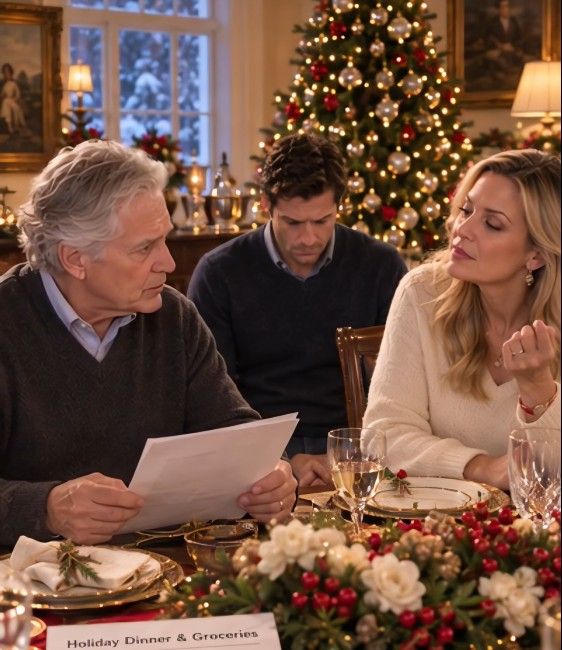
Vanessa announced that her parents would take Bruce’s bedroom, expected him to sleep on a basement pullout, and assumed he would buy groceries for a large Christmas gathering. Colin told his father everyone should pitch in. Bruce quietly called Stanley Mercer and said he was ready to change the structure. The next morning he removed Colin’s access from his accounts, closed a supplementary card, and protected Diane’s jewelry, letters, paintings, and forty-two years of handwritten notes.
“Your parents are taking my bedroom?” Bruce Bennett said. The line landed before anyone in the room had time to soften it or pretend it meant something else.
“They need the attached bathroom.” Vanessa said. No one could take the words back once they were in the air; the next silence made them feel even sharper.
Bruce Bennett answered, “You expect me to buy all this?” The answer changed the temperature of the scene, not because it was loud, but because it forced everyone present to respond to the reality already in front of them.
Then came the line that pushed the confrontation another step forward. “You have the biggest car.” Vanessa said, and the people around them watched the balance of the moment shift again.
“And plenty of free time.” Vanessa said. The words were followed by the kind of pause in which breathing, eye contact, and the smallest movement suddenly mattered.
“Come on, Dad. We should all pitch in.” Colin said. No one could take the words back once they were in the air; the next silence made them feel even sharper.
Bruce Bennett answered, “And where am I sleeping?” The answer changed the temperature of the scene, not because it was loud, but because it forced everyone present to respond to the reality already in front of them.
Then came the line that pushed the confrontation another step forward. “The pullout couch in the basement.” Vanessa said, and the people around them watched the balance of the moment shift again.
“Just let them have the room, Dad.” Colin said. The words were followed by the kind of pause in which breathing, eye contact, and the smallest movement suddenly mattered.
“Perfect.” Bruce Bennett said. No one could take the words back once they were in the air; the next silence made them feel even sharper.
Vanessa answered, “I knew you’d understand.” The answer changed the temperature of the scene, not because it was loud, but because it forced everyone present to respond to the reality already in front of them.
Then came the line that pushed the confrontation another step forward. “You were right about Colin.” Bruce Bennett said, and the people around them watched the balance of the moment shift again.
“I’m ready to change the structure.” Bruce Bennett said. The words were followed by the kind of pause in which breathing, eye contact, and the smallest movement suddenly mattered.
“What are you doing?” Vanessa said. No one could take the words back once they were in the air; the next silence made them feel even sharper.
Bruce Bennett answered, “Clearing clutter before your guests arrive.” The answer changed the temperature of the scene, not because it was loud, but because it forced everyone present to respond to the reality already in front of them.
Then came the line that pushed the confrontation another step forward. “Wonderful.” Vanessa said, and the people around them watched the balance of the moment shift again.
“Where are the groceries?” Vanessa said. The words were followed by the kind of pause in which breathing, eye contact, and the smallest movement suddenly mattered.
“I didn’t buy them.” Bruce Bennett said. No one could take the words back once they were in the air; the next silence made them feel even sharper.
Vanessa answered, “What?” The answer changed the temperature of the scene, not because it was loud, but because it forced everyone present to respond to the reality already in front of them.
Then came the line that pushed the confrontation another step forward. “I’m going to Aspen.” Bruce Bennett said, and the people around them watched the balance of the moment shift again.
“But my family arrives in two days.” Vanessa said. The words were followed by the kind of pause in which breathing, eye contact, and the smallest movement suddenly mattered.
“Then you should probably shop today.” Bruce Bennett said. No one could take the words back once they were in the air; the next silence made them feel even sharper.
Colin answered, “Dad, you can’t just leave.” The answer changed the temperature of the scene, not because it was loud, but because it forced everyone present to respond to the reality already in front of them.
Then came the line that pushed the confrontation another step forward. “I can.” Bruce Bennett said, and the people around them watched the balance of the moment shift again.
“And I am.” Bruce Bennett said. The words were followed by the kind of pause in which breathing, eye contact, and the smallest movement suddenly mattered.
On December twentieth, Bruce came downstairs with the leather suitcase he and Diane had once taken to Europe. He had not bought the groceries. When Vanessa reminded him that her family would arrive in two days, Bruce said he was going to Aspen and walked toward the door.
The next sound was small: fabric shifting, a glass settling, a shoe against the floor. Yet in Bruce’s home before Christmas, after what had just been said, it sounded enormous. Bruce Bennett stayed where the confrontation had left them and let the silence run long enough to become uncomfortable. Vanessa and Colin’s financial entitlement expected an argument, an apology, or a retreat. None came. Instead, Bruce Bennett looked once at Diane’s leather suitcase and the financial structure Bruce decided to change, then at the faces around the room. That single glance established a new order of attention. Nobody could honestly say later that they had not seen what was happening. The body remembers humiliation before the mind can organize it; Bruce Bennett felt the trembling, the heat behind the eyes, the tightness in the throat. But those reactions did not decide the next move. A slow breath did. Another followed. When Bruce Bennett finally spoke, the voice was quieter than before. Quiet forced everyone to listen. Vanessa and Colin’s financial entitlement shifted weight and tried to recover the old authority through posture, but confidence now looked like performance. The people nearby had already begun comparing what Vanessa and Colin’s financial entitlement was claiming with what they had just witnessed. That comparison was dangerous to a person who had relied on everyone accepting the loudest version of events. Nothing had been resolved yet. Pain was still present, and trust was still badly damaged. But the crisis had crossed a line: it was now visible, specific, and impossible to dismiss without choosing dishonesty in front of witnesses.
What broke the stalemate was not volume but sequence. Bruce Bennett reconstructed the last hours and the earlier warning signs in the order they had actually happened. Diane’s leather suitcase and the financial structure Bruce decided to change provided the fixed point. One fact led to the next until there was no safe place for contradiction to hide. Then came the detail nobody in the room had been prepared to hear: The statements confirmed that the supplementary card meant for genuine household support had been used heavily for spas, cosmetics, designer shoes, restaurants, and boutique clothing, with comparatively little going toward groceries. Stanley helped Bruce replace informal subsidies and vague future promises with a structure that protected Bruce’s assets and Diane’s keepsakes while requiring Colin and Vanessa to fund their own adult household. Vanessa and Colin’s financial entitlement’s expression changed before any words came. That involuntary reaction told the truth faster than a speech could have. Bruce Bennett noticed. So did everyone else. The revelation hurt because it exposed not only what had happened, but how confidently Vanessa and Colin’s financial entitlement had expected to control the interpretation afterward. Bruce Bennett let the emotion show without surrendering the conversation to it. A hand trembled. The voice caught once. Then the next question came clearly. Why had no one been told? Why had the story been arranged so that Bruce Bennett would appear unreasonable for objecting? The answers were partial and defensive. They were still answers. Each one moved the situation farther from denial and closer to consequence.
No one left the confrontation unchanged. Vanessa and Colin’s financial entitlement tried to regain control by demanding an immediate decision, but Bruce Bennett refused the manufactured deadline. The choice would be difficult enough without being made under pressure. Someone standing with Bruce Bennett agreed and asked everyone else to stop interrupting. For the first time that day, Bruce Bennett finished a sentence without someone talking over it. The effect was almost startling. Bruce Bennett described the wound beneath the visible conflict: not only what had happened, but what it meant to realize that affection had been treated as access, that generosity had been treated as obligation, or that silence had been mistaken for consent. Vanessa and Colin’s financial entitlement looked away. When the eyes returned, anger had begun to give way to fear of consequence. Bruce Bennett did not enjoy that fear. The goal was not humiliation in return. The goal was to make repetition impossible. That required facts, witnesses, and a decision that would hold after everyone went home.
