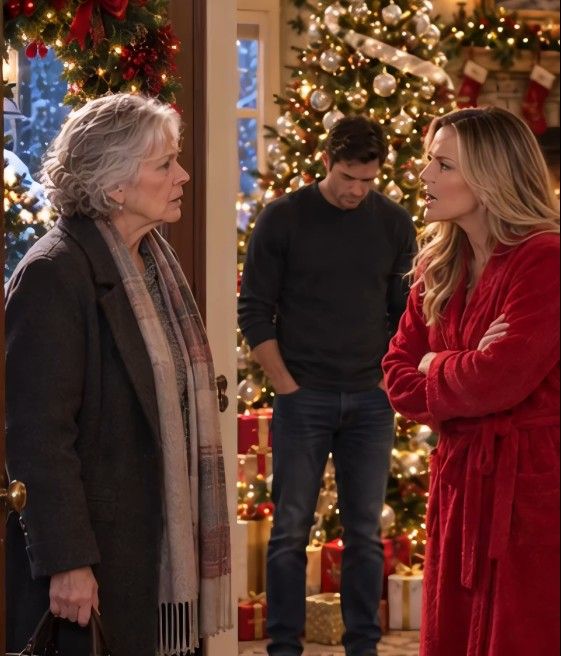
After being away for two weeks, the narrator returned to find Jessica and Matthew treating the house as theirs. They had moved into the master bedroom, displaced personal belongings, put George’s jacket in the garage, and removed the old wooden star because it did not match their décor. Matthew told his mother they needed more space as if the decision had already been made.
“Get out of my house!” Jessica said. The line landed before anyone in the room had time to soften it or pretend it meant something else.
“Your house?” Narrator said. No one could take the words back once they were in the air; the next silence made them feel even sharper.
Narrator answered, “This house belongs to me.” The answer changed the temperature of the scene, not because it was loud, but because it forced everyone present to respond to the reality already in front of them.
Then came the line that pushed the confrontation another step forward. “Matthew said we’d be living here now.” Jessica said, and the people around them watched the balance of the moment shift again.
“Matthew?” Narrator said. The words were followed by the kind of pause in which breathing, eye contact, and the smallest movement suddenly mattered.
“Where is George’s jacket?” Narrator said. No one could take the words back once they were in the air; the next silence made them feel even sharper.
Jessica answered, “Garage, probably.” The answer changed the temperature of the scene, not because it was loud, but because it forced everyone present to respond to the reality already in front of them.
Then came the line that pushed the confrontation another step forward. “And George’s star?” Narrator said, and the people around them watched the balance of the moment shift again.
“That old wooden thing? It didn’t match.” Jessica said. The words were followed by the kind of pause in which breathing, eye contact, and the smallest movement suddenly mattered.
“Why are your things in my bedroom?” Narrator said. No one could take the words back once they were in the air; the next silence made them feel even sharper.
Jessica answered, “Because this is our room now.” The answer changed the temperature of the scene, not because it was loud, but because it forced everyone present to respond to the reality already in front of them.
Then came the line that pushed the confrontation another step forward. “Mom, we needed more space.” Matthew said, and the people around them watched the balance of the moment shift again.
“You have an apartment.” Narrator said. The words were followed by the kind of pause in which breathing, eye contact, and the smallest movement suddenly mattered.
“Our lease ended.” Matthew said. No one could take the words back once they were in the air; the next silence made them feel even sharper.
Narrator answered, “And you chose not to renew it?” The answer changed the temperature of the scene, not because it was loud, but because it forced everyone present to respond to the reality already in front of them.
Then came the line that pushed the confrontation another step forward. “Why pay rent when this house is sitting here?” Jessica said, and the people around them watched the balance of the moment shift again.
“I was gone for two weeks.” Narrator said. The words were followed by the kind of pause in which breathing, eye contact, and the smallest movement suddenly mattered.
“We knew you’d make it complicated.” Jessica said. No one could take the words back once they were in the air; the next silence made them feel even sharper.
Narrator answered, “Did you tell her this house would be yours?” The answer changed the temperature of the scene, not because it was loud, but because it forced everyone present to respond to the reality already in front of them.
Then came the line that pushed the confrontation another step forward. “Someday.” Matthew said, and the people around them watched the balance of the moment shift again.
“You can stay in the spare room.” Jessica said. The words were followed by the kind of pause in which breathing, eye contact, and the smallest movement suddenly mattered.
“We’re keeping the master bedroom.” Jessica said. No one could take the words back once they were in the air; the next silence made them feel even sharper.
Narrator answered, “You have forty-eight hours.” The answer changed the temperature of the scene, not because it was loud, but because it forced everyone present to respond to the reality already in front of them.
Then came the line that pushed the confrontation another step forward. “To do what?” Jessica said, and the people around them watched the balance of the moment shift again.
“Remove everything you brought into my home.” Narrator said. The words were followed by the kind of pause in which breathing, eye contact, and the smallest movement suddenly mattered.
“I have never been more serious.” Narrator said. No one could take the words back once they were in the air; the next silence made them feel even sharper.
The narrator gave them forty-eight hours to remove their things and return the house to the condition in which they found it. She had not invited them to inherit her life early, and the property papers made clear that the home was still hers.
The crisis did not dissolve when the last voice fell silent. It became heavier. The narrator remained in the narrator’s house at Christmas, aware of every detail the body had ignored during the confrontation: the ache in the jaw, the dry mouth, the pulse in the wrists, the unnatural stillness of people who were waiting to see who would move first. The changed bedroom, George’s missing jacket, and the removed wooden star sat inside that stillness like a question no one could push aside. Jessica and Matthew’s takeover of the narrator’s home tried a familiar expression — part annoyance, part disbelief — but it did not produce the old result. The narrator did not shrink. The people around them did not immediately look away. That was the first real break in the pattern. The narrator took one careful breath and let the shock become information instead of panic. Who had seen what? Which claim could be tested? Which decision could not be undone once made? Those questions arrived one after another. They were practical, almost plain, and because of that they were powerful. Jessica and Matthew’s takeover of the narrator’s home had expected emotion to make the narrator easier to control. Instead, emotion sharpened the need for clarity. No one in the room was ready for what came next, but everyone understood that the next answer had to be grounded in something stronger than loyalty, shame, or family pressure.
There was a moment when the narrator nearly stopped. The next fact would change relationships, not just end an argument. But withholding it would preserve exactly the arrangement that had caused the damage. So the narrator continued. The explanation began with the changed bedroom, George’s missing jacket, and the removed wooden star and ended with the truth that had been protected from view: Matthew admitted he had told Jessica that the house would probably be his eventually and had allowed that expectation to turn into a present-tense claim. No deed transfer or gift existed. Jessica believed she was moving into a family asset with Matthew’s permission, while Matthew had never asked the one person whose permission mattered. Nothing in the room moved for a beat. Even Jessica and Matthew’s takeover of the narrator’s home seemed stunned by how complete the picture became once the missing piece was named. The first response was denial. The second was minimization. The third was an attempt to blame the pressure of the situation. The narrator listened to all three and then asked a simple question: which choice, specifically, had someone else forced Jessica and Matthew’s takeover of the narrator’s home to make? No answer came. That silence did not make the narrator feel powerful. It made the narrator sad. Accountability was necessary, but necessity did not make it painless.
