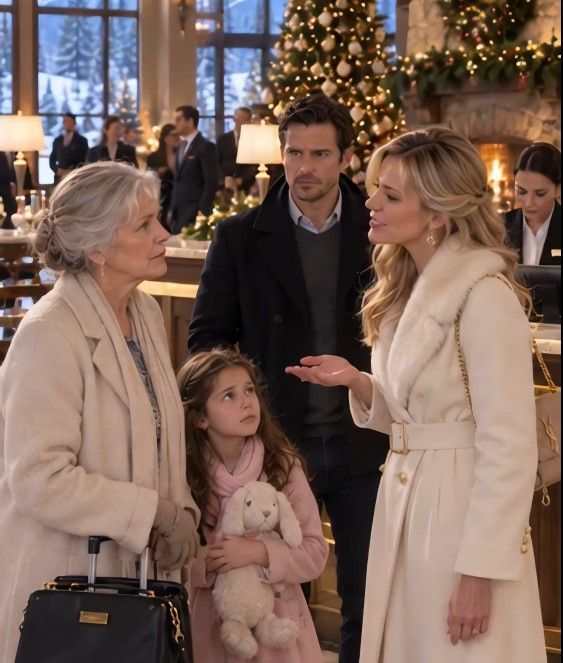
Madison Caldwell humiliated Elaine at Silver Pines Lodge, told her she had not paid for the vacation, and claimed there was no reservation for her. Daniel tried to avoid drama while little Lily offered Grandma her own bed. Elaine calmly called Marcus. When he arrived, he asked whether she wanted her suite prepared.
“You didn’t pay for this vacation, Elaine.” Madison Caldwell said. The line landed before anyone in the room had time to soften it or pretend it meant something else.
“I don’t see a reservation.” Concierge said. No one could take the words back once they were in the air; the next silence made them feel even sharper.
Elaine Caldwell answered, “Elaine Caldwell.” The answer changed the temperature of the scene, not because it was loud, but because it forced everyone present to respond to the reality already in front of them.
Then came the line that pushed the confrontation another step forward. “Did you know?” Elaine Caldwell said, and the people around them watched the balance of the moment shift again.
“Don’t turn this into drama.” Madison Caldwell said. The words were followed by the kind of pause in which breathing, eye contact, and the smallest movement suddenly mattered.
“Grandma, you can sleep in my bed.” Lily said. No one could take the words back once they were in the air; the next silence made them feel even sharper.
Elaine Caldwell answered, “Grandma won’t need your bed.” The answer changed the temperature of the scene, not because it was loud, but because it forced everyone present to respond to the reality already in front of them.
Then came the line that pushed the confrontation another step forward. “Then where will you sleep?” Madison Caldwell said, and the people around them watched the balance of the moment shift again.
“Who are you calling? Your taxi?” Madison Caldwell said. The words were followed by the kind of pause in which breathing, eye contact, and the smallest movement suddenly mattered.
“Hello, Marcus.” Elaine Caldwell said. No one could take the words back once they were in the air; the next silence made them feel even sharper.
Marcus Whitmore answered, “You’re here?” The answer changed the temperature of the scene, not because it was loud, but because it forced everyone present to respond to the reality already in front of them.
Then came the line that pushed the confrontation another step forward. “Yes.” Elaine Caldwell said, and the people around them watched the balance of the moment shift again.
“No.” Elaine Caldwell said. The words were followed by the kind of pause in which breathing, eye contact, and the smallest movement suddenly mattered.
“Mom… who is Marcus?” Daniel said. No one could take the words back once they were in the air; the next silence made them feel even sharper.
Marcus Whitmore answered, “Mrs. Caldwell.” The answer changed the temperature of the scene, not because it was loud, but because it forced everyone present to respond to the reality already in front of them.
Then came the line that pushed the confrontation another step forward. “Marcus.” Elaine Caldwell said, and the people around them watched the balance of the moment shift again.
“Would you like your suite prepared?” Marcus Whitmore said. The words were followed by the kind of pause in which breathing, eye contact, and the smallest movement suddenly mattered.
“Her suite?” Madison Caldwell said. No one could take the words back once they were in the air; the next silence made them feel even sharper.
The bronze plaque near the entrance carried the name everyone had ignored: SILVER PINES LODGE. EST. 1928. A CALDWELL HERITAGE PROPERTY. Madison had spent the confrontation treating Elaine as an unwanted guest inside property tied directly to Elaine’s family.
Nobody delivered a perfect speech. There was only Silver Pines Lodge, the aftermath of a scene nobody could unsee, and Elaine Caldwell trying to make the next breath reach the bottom of the lungs. The bronze plaque identifying Silver Pines Lodge as a Caldwell heritage property remained the fixed point in the room. Every time Madison Caldwell’s exclusion and entitlement looked toward it, a fraction of certainty disappeared. Elaine Caldwell noticed that and resisted the temptation to rush. Rushing had always helped the person applying pressure; it forced decisions before the hurt could be named. So Elaine Caldwell allowed the pause. Eyes moved. Hands stopped fidgeting. Someone near the edge of the scene took half a step closer, not to intervene dramatically, but to make it clear that Elaine Caldwell would not be standing alone. That tiny movement mattered more than a shouted promise. Madison Caldwell’s exclusion and entitlement began to speak, stopped, and tried again. The usual explanations no longer fit the visible facts. Elaine Caldwell felt anger, but underneath it was something colder and steadier: recognition. This was not one unfortunate sentence that could be forgiven by morning. It was the result of choices. What came next would have to be about choices too — who told the truth, who protected whom, who accepted consequences, and who refused to participate in the old arrangement any longer.
The hidden truth arrived at the worst possible time for Madison Caldwell’s exclusion and entitlement: when too many people were already paying attention. Elaine Caldwell did not announce it with satisfaction. Elaine Caldwell simply connected the bronze plaque identifying Silver Pines Lodge as a Caldwell heritage property to the detail that had been withheld. The lodge was held through the Caldwell family trust, and Elaine was the current trustee with authority over family-use privileges. Madison and Daniel had booked the gathering using privileges that existed only because Elaine had kept the property available to the family. There had never been a legitimate basis to exclude her from her own suite. A sharp stillness crossed the room. The revelation made several earlier statements impossible to maintain. Madison Caldwell’s exclusion and entitlement tried to speak over the reaction, but the old technique failed because the witnesses had already heard enough to compare versions for themselves. Elaine Caldwell watched one face after another shift from uncertainty to recognition. That communal recognition mattered. For a long time, the burden of interpretation had belonged to Elaine Caldwell alone; every hurt had been followed by a demand to question whether it was really that serious. Now the facts were shared. Elaine Caldwell did not have to persuade anyone to feel the injury. The injury had become visible in the structure of what had happened. Madison Caldwell’s exclusion and entitlement finally asked what Elaine Caldwell wanted. The question sounded almost offended, as if consequences were a new cruelty rather than the natural result of the truth. Elaine Caldwell answered that wanting could come later. First, everyone was going to finish hearing what happened.
The most painful part of the confrontation came when someone asked Elaine Caldwell why the behavior had been tolerated for so long. The question was not meant cruelly, but it landed hard. Elaine Caldwell took a breath and answered without defending the past: love, hope, habit, fear of splitting the family, and the belief that the next apology might be the one that changed things. Madison Caldwell’s exclusion and entitlement looked almost relieved, as if those reasons could be used as proof that the situation had not been serious. Elaine Caldwell stopped that interpretation immediately. Staying did not make the harm acceptable. Hoping did not create consent. A nearby ally nodded, and the room became quiet again. In that moment the confrontation shifted from a dispute over facts to a recognition of impact. That recognition opened the door to the difficult choice waiting next.
The difficult choice was not whether Madison Caldwell’s exclusion and entitlement deserved consequences. By then, that part was clear. The difficult choice was how much of the old family structure Elaine Caldwell was willing to lose in order to make safety and truth nonnegotiable. Elaine chose not to throw the entire family into the snow or cancel the holiday. She kept her suite, revoked Madison’s ability to control future family bookings, and told Daniel that staying married to Madison was his decision but asking Elaine to accept humiliation was no longer an option. Saying the decision out loud made Elaine Caldwell’s hands shake. There was grief in it, because boundaries often sound simple from outside and feel like mourning from inside. Madison Caldwell’s exclusion and entitlement immediately treated the choice as betrayal. Elaine Caldwell did not argue about the label. Instead, Elaine Caldwell explained the condition in practical terms: no private pressure, no access assumed without permission, no financial or emotional obligation created by someone else’s expectation, and no reconciliation purchased with a rushed apology. The room absorbed the seriousness of it. Someone among the people supporting Elaine Caldwell asked whether Elaine Caldwell was sure. It was the right question because it respected agency rather than demanding courage. Elaine Caldwell answered after a long pause. Yes. Not because there was no fear, but because fear had been running the household for too long.
Consequences gathered one by one, each attached to something Madison Caldwell’s exclusion and entitlement had actually done. Madison lost the social authority she had built around controlling the lodge. Staff followed the trust terms, not her demands. Guests learned that the person she had mocked was the one whose stewardship kept the property available. Her ability to exclude Elaine ended permanently. There was no need for Elaine Caldwell to exaggerate. In fact, the plainness of the facts made them harder to escape. Madison Caldwell’s exclusion and entitlement’s face changed when it became clear that the outcome would continue even if the argument stopped. Access had changed. Authority had changed. Other people had information now. What had once depended on secrecy could no longer be rebuilt in the same form. Madison Caldwell’s exclusion and entitlement looked around for someone to say the situation had gone too far. Nobody did. The most painful reaction came from a person who had been hurt earlier and who now simply looked at Madison Caldwell’s exclusion and entitlement without fear. That look lasted only a second, but it marked the true end of the old hierarchy. Madison Caldwell’s exclusion and entitlement lowered the eyes first. Afterward, the room went so quiet that the smallest mechanical sounds became noticeable. That silence allowed everyone to understand that this was not another temporary fight. Something had actually ended.
Consequences kept unfolding after the crowd dispersed. The holiday continued in separate spaces. Elaine spent time with Lily and relatives who treated her kindly, while Daniel and Madison faced the consequences of their behavior without access to Elaine’s suite or account privileges. Elaine Caldwell discovered that justice was not one dramatic reversal but a series of ordinary corrections. Something was returned. Something was canceled. Someone else took responsibility for a cost. A private decision became a documented one. Madison Caldwell’s exclusion and entitlement’s ability to revise the story weakened with every concrete step. For Elaine Caldwell, that mattered more than winning the final argument.
The silence after the downfall gave the supporting characters nowhere to hide. One of the people who had failed Elaine Caldwell was the first to speak and did so without excuses. The apology was concrete. The failure was named. Elaine Caldwell asked one question: what would be different next time? The answer mattered more than remorse. Together they made a plan that redistributed responsibility instead of placing all vigilance on Elaine Caldwell. That plan included who would hold documents, who would accompany difficult meetings, who would handle practical arrangements, and who would be told immediately if pressure started again. The details were unglamorous. They were also what safety looked like.
Life widened beyond Elaine Caldwell and Madison Caldwell’s exclusion and entitlement. Daniel apologized for minimizing the scene and later established boundaries with Madison. Madison’s access to heritage-property privileges remained restricted. Marcus returned to his normal management role once Elaine’s authority was formally recorded and no longer contested. People who had been silent found their voices. People who had been dependent learned to carry more of their own weight. Those who remained close became companions rather than rescuers. Those shifts kept the ending from resting entirely on Elaine Caldwell’s strength.
Healing happened through conversations that were less dramatic and more difficult than the showdown. Elaine stopped treating every family invitation as a test of whether she was wanted. She used the lodge on her own terms, sometimes alone, sometimes with Lily, and discovered that solitude chosen freely felt entirely different from exclusion. In the first conversation, Elaine Caldwell refused the phrase ‘move on’ unless it meant moving with the truth rather than away from it. The second conversation was about trust. Elaine Caldwell explained that trust would not return because someone cried, promised, or invoked family. It would return, if at all, through repeated behavior that respected boundaries without needing reminders. Someone in that support circle listened and asked what respect would look like in practical terms. Elaine Caldwell answered slowly: asking before deciding, accepting no the first time, separating love from money, not using private vulnerabilities as public weapons, and never asking the person who was hurt to protect the reputation of the person who caused the hurt. Saying those rules aloud felt strangely formal, but formality had value. It turned healing from a mood into a practice. Weeks later, the changes were visible in small scenes. A phone call ended when Elaine Caldwell said they were tired. A visit was scheduled rather than assumed. A difficult topic was raised in daylight with another trusted person present. When somebody made a mistake, the apology came without a demand for immediate forgiveness. These moments lacked the intensity of the original confrontation, and that was exactly why they mattered. Safety often looks boring from the outside. To Elaine Caldwell, boredom became a luxury.
The next boundary test came sooner than Elaine Caldwell expected. A request arrived in the familiar urgent tone, asking for an exception because the situation was supposedly different this time. Elaine Caldwell read it twice before answering. In the past, the word urgent would have erased every other consideration. Now it triggered a question: urgent for whom? The answer made the decision clearer. Elaine Caldwell responded with one calm sentence that preserved the boundary and offered only the help that could be given freely. There was disappointment on the other end, but no catastrophe followed. The world did not collapse because Elaine Caldwell said no. That ordinary discovery became one of the clearest signs that healing had begun. Later, someone in Elaine Caldwell’s support circle asked whether guilt had appeared. It had. The difference was that guilt no longer received decision-making authority. They talked about how strange it felt to let an uncomfortable feeling exist without immediately paying money, changing plans, surrendering space, or apologizing for having needs. The conversation ended with both of them laughing softly at how revolutionary something so basic could feel.
