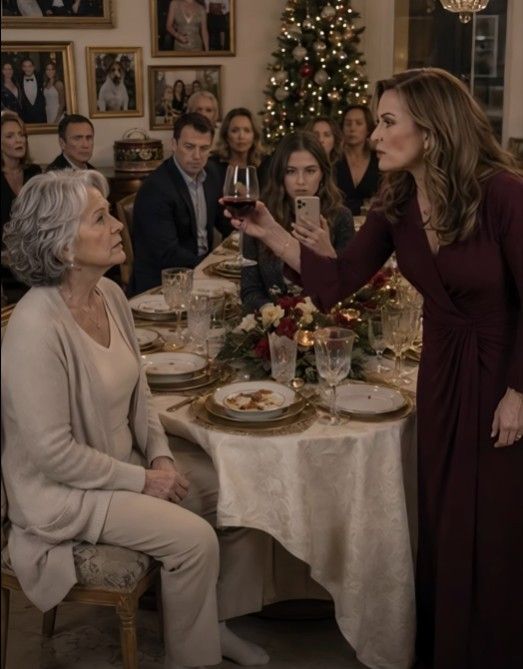
“The scene was already in motion in the Chicago-suburb Christmas house. The people and physical details were fixed by the source: Eleanor, Harper, Liam, Madison, dinner guests, gold-rimmed tableware, wine glass, phone, socks, cookie tin location, practical Christmas lighting, furniture positions, screen direction, and restrained 35–50mm prestige-television realism. Eleanor was not entering a calm conversation; the conflict had already reached the point where ordinary family expectations, money, property, work, or belonging were being used as pressure. Nothing about the moment felt abstract. Voices were close, faces were visible, and every object named in the source carried the weight of what had happened before the camera arrived.
The first exchange came in clipped, remembered lines. Harper said, “This family would be happier if you didn’t exist.”; Eleanor said, “You knew this was coming.”; Harper said, “Don’t make this dramatic.”; Eleanor said, “Consider that wish granted.”; Harper said, “This is a private family dinner.”. The words mattered not because they were eloquent but because they exposed the hierarchy in the room. Eleanor was expected to absorb the insult, do the task, leave the seat, sign the paper, pay the bill, accept the story, or disappear from the decision. Instead, the silence after those lines began to change shape. It was no longer simple submission. It was attention.
The pressure kept moving rather than resetting. Arthur Sterling said, “Mrs. Duran invited me.”; Harper said, “She’s only a guest in my home.”; Arthur Sterling said, “No, Mrs. Duran. You are.”. Each response narrowed the distance between what Harper wanted everyone to believe and what the visible facts could support. People nearby began reacting with small things: a glass paused halfway up, a hand stopped moving, someone looked at a folder twice, someone who had been laughing became suddenly interested in the table. Eleanor noticed those changes because they meant the conflict was no longer fully private.
Then the source deliberately stopped before the payoff. The unresolved material included: why Harper is the guest a deed, trust, ownership document, lease, estate arrangement, inheritance, sale, eviction, financial consequence, police involvement, or final family outcome. Those withheld facts did not vanish; they became the open door into the true ending. Eleanor stood at that threshold with the emotional damage already done and with one practical question left: what would happen when the people who had been speaking with certainty were forced to stay in the room long enough for the record to be checked?
No one received a magical rescue. There was only the exact physical aftermath of the last source-supported beat: a room, a table, a doorway, a screen, a document, a key, a phone, a suitcase, a bill folder, or another ordinary object suddenly carrying extraordinary importance. That is where the continuation begins.
Nothing moved for one long second. Then Eleanor did. A hand lowered. A breath that had been trapped high in the chest came out slowly. The smallest movement mattered because it was the first thing in the confrontation that belonged entirely to Eleanor. Across the Chicago-suburb Christmas house, Harper waited for the old reflex: an apology, a retreat, a quick effort to keep everyone comfortable. It did not come. Eleanor looked once at the object or record that had stopped the argument and then at the faces around it. “We are going to finish this,” Eleanor said. The voice was not loud. That made the sentence harder to dismiss. It was no longer a request to be treated better. It was a decision that the truth could stay in the room even if the truth embarrassed people who had counted on silence.
The first response from Harper was explanation rather than remorse. Context had been misunderstood. Everyone was stressed. The words had come out wrong. The decision had only been practical. The explanation arrived too fast and tried to make the scene smaller than it was. Eleanor listened without interrupting. That silence forced the story to continue until it started contradicting itself. Someone glanced toward Liam, Madison, and Arthur Sterling. Someone else studied the floor. A person who had seemed certain minutes earlier now rubbed both hands together as if friction could produce a safer version of events. Eleanor asked ordinary questions instead of making grand accusations. Who made the decision? Who knew? When? What authority did anyone actually have? What had been paid, signed, moved, promised, recorded, or assumed? The questions were plain enough that drama had nowhere useful to hide.
That was when the hidden truth surfaced at the worst possible moment for Harper: the home was controlled by an arrangement created for Eleanor while Harper’s occupancy depended on permission she had mistaken for ownership. It did not arrive as a thunderclap. It came in pieces. the source-supported objects, dialogue, records, witnesses, and unresolved details tied to the Chicago-suburb Christmas house. One detail supported another. A timestamp matched a statement. A payment explained a demand. A written instruction contradicted an assumption. A witness remembered the same phrase somebody now wished had never been said. Eleanor felt anger rise, but beneath the anger was recognition. This had not begun in the last ten minutes. The last ten minutes had only made the pattern visible. Generosity had become entitlement. Silence had been mistaken for permission. The person expected to absorb the discomfort had been paying closer attention than anyone believed.
The room reacted before anyone found language for it. A glass touched the table too carefully. A chair scraped once and stopped. Someone inhaled sharply. Another person looked away from Eleanor because eye contact now required acknowledging what had been allowed to happen. Harper tried anger next. The volume rose. The accusation turned toward Eleanor: cruel, unnecessary, dramatic, vindictive, humiliating. Eleanor let the words pass. “No,” Eleanor said when there was finally space. “The humiliation happened before I answered it.” That sentence changed where the burden sat. For once, the person harmed was not required to make the person who caused the harm feel innocent. The silence that followed was not empty. It was the first public recognition that consequence and cruelty were not the same thing.
Then came the hard choice. Eleanor could surrender again in the name of keeping the family intact, or impose a boundary that might permanently change the relationship. The easy version of power would have been immediate punishment. The familiar version of love would have been immediate rescue. Eleanor chose neither. There would be consequences tied to conduct. There would be compassion only where compassion did not erase facts. “I am not deciding whether I love you,” Eleanor said. “I am deciding what I will allow.” Someone began crying. Another person tried to interrupt with an old family memory. Eleanor stopped that gently. Childhood, sacrifice, grief, and blood could matter without overruling consent. Love could remain. Access could change. A relationship might someday heal. The arrangement that had enabled the harm would not continue simply because ending it felt awkward.
Harper bargained. A private apology could make this disappear. A promise could replace documentation. The family did not need outsiders, records, professionals, managers, attorneys, staff, board members, or witnesses involved. Eleanor asked one question: “Would you be apologizing if this had stayed hidden?” Nobody answered. The lack of an answer did more than shouting could have done. Liam, Madison, and Arthur Sterling did not celebrate. People who cared about Eleanor looked tired, because accountability inside a family rarely feels like victory while it is happening. It feels like grief for the relationship everyone thought they had. Still, grief was not a reason to restore the old arrangement. The facts were checked carefully, and supportive people were not allowed to exaggerate them. The truth was already enough.
The downfall came from the structure Harper had abused, not from a new weapon invented by Eleanor. Harper lost household authority and moved out under written transition terms after the family saw whose generosity had made the home possible. The decisive shift was visible. A key changed hands. An authorization disappeared. A payment stopped. A document was corrected. A chair no longer belonged to the person who had claimed it. A room full of people simply stopped accepting the explanation they had accepted yesterday. Harper looked around for the familiar rescue: someone to laugh, someone to say everybody should calm down, someone to blame Eleanor for making things public. No rescue came. The irreversible part was not only financial, legal, professional, or practical. It was social. Power had depended on other people agreeing not to look too closely. They were looking now.
Afterward came the silence the entire confrontation had been moving toward. Not cinematic silence. Domestic silence. Air conditioning. A refrigerator motor. Shoes against a floor. Someone closing a cabinet in another room. The ordinary sounds felt almost indecent because something major had ended while the outside world continued normally. Eleanor sat down and let the body catch up with the decision. Anger drained first, leaving exhaustion. Then sadness. This was not grief over winning. It was grief over how much pain had been required before simple respect became nonnegotiable. Liam, Madison, and Arthur Sterling moved closer but did not touch until Eleanor gave the smallest nod. That consent mattered too. It corrected, in one quiet gesture, a day built from other people assuming they knew what Eleanor should accept.
The first healing conversation began badly. Someone who had stayed silent admitted, “I saw more than I said.” Eleanor did not rush to make that confession easier. Why had silence seemed safer? What had the silent person feared losing? What had Eleanor lost because they chose that safety? The answers were not heroic: convenience, fear of an argument, money, routine, divided loyalty. Yet saying them out loud replaced vague regret with specific responsibility. Eleanor described one wound rather than every wound. A look. A sentence. The exact second hope turned into embarrassment. The listener stayed in the room and heard it without asking for immediate forgiveness. That was the first repair. Not reconciliation. Not absolution. The simple decision not to run from the memory that made repair necessary.
Practical consequences followed. Anything involving money, property, work, travel, housing, inheritance, event approval, business access, or family support was separated from emotion long enough to be written clearly. Who owned what? Who was responsible for which bill? Who could sign? Who could enter? Who could make a reservation, submit a document, change a lock, use an account, claim an object, or speak for someone else? The answers were put in plain language. This initially felt cold to people accustomed to informal family arrangements. Then everyone discovered the opposite. Clarity reduced suspicion. A gift no longer purchased the right to insult someone. A family title no longer substituted for consent. A promise no longer became true just because it had been repeated for years.
The next morning mattered because the boundary was still there. Harper had expected sleep to soften Eleanor, or guilt to arrive with daylight. Instead, the same decision waited at breakfast, in the inbox, on the account, at the door, or in the written plan. There was no new argument. Eleanor did not need one. When a message arrived trying to reopen the entire conflict, Eleanor answered only the practical question inside it. The rest went unanswered. This was unfamiliar power: not dominance, but refusal to be dragged back into a script simply because someone else knew the lines. The world did not collapse. Other adults solved problems they had long handed to Eleanor. The first day without rescue became proof that they had always been more capable than their dependence suggested.
Over the next week, the people around Eleanor divided into two groups. Some became warmer because they finally understood the cost of what they had called peace. Others became briefly colder because the old arrangement had benefited them too. Eleanor stopped chasing either reaction. Approval had been part of the trap, and so had fear of disapproval. The new measure was simpler: was the request fair, was the information true, was consent present, and did the arrangement allow everyone involved to keep their dignity? Those questions sounded almost boring compared with the confrontation. That was exactly why they worked. A healthy life was not supposed to require a crisis every time someone said no.
Eventually Harper asked for a private conversation. Eleanor agreed only under conditions that felt safe. The apology began with explanations. Eleanor stopped it. “Tell me what you did before you tell me why.” The sentence forced a different kind of honesty. Specific acts were named. So were the words. Entitlement was admitted where entitlement existed. Cowardice was admitted where somebody had chosen silence. Convenience was admitted where it had been easier to believe a story that kept Eleanor small. Not every defense disappeared. Eleanor did not mistake partial honesty for complete change. “I can believe you are sorry today,” Eleanor said. “Trust is whether you are different tomorrow.” No dramatic embrace followed. The lack of one made the scene more truthful.
Supporting characters needed closure too. Liam, Madison, and Arthur Sterling could not remain merely the people who helped expose the truth. Each person had to decide what they would do differently. One corrected a false story. One returned something. One paid something. One apologized for laughing, staying quiet, or assuming the easiest explanation. Someone younger asked the question adults had avoided: “Why didn’t anyone just ask?” Eleanor answered without poisoning the child against anyone. “Sometimes grown-ups get used to taking the easiest path. We’re learning a better one.” The child accepted that answer more easily than the adults did. Children often understand boundaries when adults stop decorating them with guilt.
There were setbacks. One phone call ended abruptly. A message arrived with a sentence that sounded like the old manipulation. Eleanor did not answer immediately. That pause became another habit. There was no requirement to solve every emotion the instant somebody delivered it. When Harper tested the boundary, the consequence already agreed upon was applied without a new debate. When someone respected the boundary, Eleanor noticed and said so. Change became measurable through small acts: asking before entering, paying before promising, telling the truth before being cornered, accepting no without punishing the person who said it. None of those acts were as dramatic as the confrontation. They were more important.
Weeks passed before Eleanor realized the body had begun to relax. Sleep came more easily. Meals were eaten while still warm. A ringing phone no longer produced immediate dread. The place where the confrontation happened became only the Chicago-suburb Christmas house again, not a permanent warning. Trauma attaches itself to ordinary places—a kitchen doorway, restaurant chair, lobby, table, suitcase, document, or phone. Healing did not erase the memory. It gave the memory competition. New conversations happened in the same spaces. Nobody demanded a performance of gratitude. Eleanor began to understand safety not as the absence of conflict, but as confidence that conflict would not erase personhood.
A final family or community gathering tested the repair without becoming another spectacle. Seating was discussed before people arrived. Costs were divided without hints. Nobody assigned Eleanor a role. When an old kind of joke began to form, somebody else stopped it before Eleanor had to. That tiny intervention landed more deeply than a dramatic apology. It showed that the lesson had moved beyond Eleanor’s own vigilance. Later, while dishes were carried away, coats gathered, doors locked, or lights dimmed, Eleanor noticed that nobody was watching for an explosion. There was no hidden plan waiting to punish someone and no humiliating reveal left to perform. The absence of drama felt almost luxurious.
Then came the beautiful surprise, connected not to a new danger but to something that had been present all along: Eleanor later turned an unused suite into a welcoming room for older relatives who had stopped traveling because they feared being burdens. At first Eleanor simply stared. The detail was small enough that, during the worst part of the conflict, it would have seemed irrelevant. Now it carried a different weight. It proved the story had never been only about what was taken. Something had been preserved too: a memory, a promise, a piece of work, a child’s trust, an old kindness, a place to belong. Eleanor laughed and cried at the same time, embarrassed by neither. Someone nearby reached out, stopped short, and waited. Eleanor closed the distance voluntarily. The gesture did not erase what happened. It showed tenderness could return without pretending the wound had never existed.
The final months were quieter than anyone would have predicted on the day everything broke open. There were no grand speeches about survival. There were groceries, ordinary bills, repaired routines, and difficult conversations that ended better than they began. Eleanor learned the practical joy of making a plan without wondering who would object. The people who remained close learned to ask instead of assume. Even Harper, where contact continued, had to approach without the old guarantees. Sometimes that meant hearing no. Sometimes it meant sitting in discomfort. Sometimes it meant accepting that an apology earned the next conversation, not the restoration of everything that had been lost.
On an ordinary evening, Eleanor remembered the exact second the old pattern broke. Memory preserved the temperature of the room, the object on the table, the face of someone realizing control was slipping. But the memory no longer ended there. It now extended into everything afterward: the evidence checked carefully, the difficult choice made without shouting, the consequence that held, the first honest apology, the first peaceful morning. The meaning of the story had changed. It was no longer about the day Eleanor was humiliated. It was about the day humiliation stopped buying anyone access to Eleanor’s life.
The last scene belonged to no villain and no document. Eleanor placing a fresh guest key on a table for an aunt arriving the next Christmas. There was nothing left to prove. The people present knew the rules because the rules had become ordinary: ask, listen, tell the truth, repair what you damage, and never mistake love for permission. Eleanor let the moment stay small. Warm light. Everyday sound. A hand resting where it chose to rest. For years peace had meant keeping everybody else comfortable. Now peace meant being able to remain fully present without disappearing. That difference was the ending. Not perfect. Not forgotten. Complete enough to feel like home.
One more practical scene mattered. Eleanor sat with the remaining records and assigned every continuing obligation to the person who actually owned it. No vague phrase like ‘family helps family’ could hide a recurring charge, a housing expectation, a business duty, or a future promise. If help was offered, the amount and purpose were clear. If access was granted, the limit was clear. If a kindness was given, nobody could later convert it into a debt. The precision felt almost tender after so much confusion. It meant people could say yes without being trapped and no without being punished. Eleanor discovered that written clarity was not the enemy of family warmth. It was often what allowed warmth to exist without fear.
There was also a day when Eleanor nearly returned to the old reflex. Someone sounded overwhelmed, and the problem could have been solved quickly if Eleanor stepped in, paid, signed, organized, apologized, or surrendered one small boundary. The body leaned forward before the mind caught up. Then Eleanor waited ten minutes. In those ten minutes the other person solved part of the problem alone. The crisis shrank. Eleanor helped with one specific piece only after being asked respectfully, then stopped. The world did not collapse. That afternoon mattered almost as much as the showdown because it proved the new life was sustainable. Boundaries were no longer emergency measures. They were ordinary architecture.
Forgiveness, where it became possible at all, appeared as permission for one ordinary act rather than a declaration. A cup of coffee. A short visit. A ride. A meal. Eleanor chose the gesture carefully and made sure it was not being offered to erase consequence. The recipient understood. “Thank you for letting me do this,” they said. Not thank you for forgetting, not thank you for moving on. Just this. Earned reconciliation turned out to be smaller and slower than people imagined. It was built from repeated moments in which nobody reached beyond the permission actually given. Over time those moments made a narrow bridge across a place that once looked impossible to cross.
By then Eleanor had a rule for new decisions: no urgency created by somebody else could cancel informed consent. Requests waited until facts were checked. Decisions tied to the Chicago-suburb Christmas house were made only by people who actually had authority. When guilt appeared, Eleanor answered once and stopped. Silence no longer belonged to fear; it belonged to certainty. Friends learned they did not need exaggerated accusations to defend Eleanor. They only needed to respect the boundary and tell the truth about what they had personally seen. Nobody had to become cruel in order for cruelty to stop. That was how the ending stayed human instead of turning into another revenge story.”
