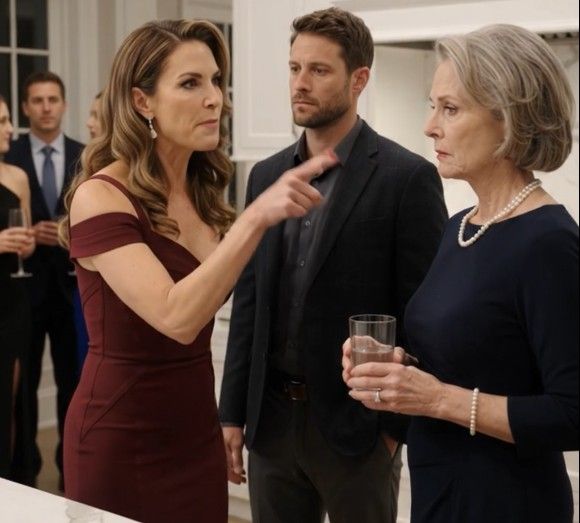
“Get this embarrassment out of my house before the Hendersons see her.”
Camille said it to my son while I stood in her kitchen holding a casserole dish. She was celebrating her promotion to partner at Drysdale, Hewitt & Marsh, and she had apparently decided that her sixty-seven-year-old mother-in-law would spoil the occasion.
My name is Hazel Voorhees. I had put on my navy dress and Walter’s pearls that afternoon. My husband had saved secretly to buy those pearls years before he died, and I still touched the clasp when I needed to steady my hands.
Theo saw me before Camille did. His mouth opened, then closed. He took the casserole, my mother’s chicken and wild rice recipe, and put it behind a stack of catering trays.
“Mom, maybe this isn’t a good time.”
I set down the glass of water he had given me and walked out.
At the curb, I discovered I had left my coat inside. I went back for it because it was cold, and because I refused to turn my own coat into another thing I was too embarrassed to claim. Theo met me in the hall. Upstairs, my granddaughter Poppy was calling for someone to find her silver shoes.
“I’ll bring your dish tomorrow,” he said.
“Keep it until it’s empty.”
He looked relieved, mistaking an instruction about cookware for forgiveness. I buttoned my coat while his wife laughed somewhere beyond the kitchen.
I had been a widow for nineteen years. When Walter died in 2007, he left behind a business we had built together, starting with one leaking strip mall in Tulsa. We owned twenty-three buildings when he died. Now there were fifty-three, including the building where Camille’s prestigious firm rented three floors.
I owned that property through Lakeshore Glen LLC. I also held a 46 percent ownership interest in the firm, an arrangement administered with my attorney Geraldine and disclosed through the firm’s governing records. Camille’s work had never required her to review my ownership documents. She knew the names she needed to impress, and she thought she already knew mine.
I had approved her compensation package when Geraldine called. I had been proud of her. Ambition was not something I despised. What hurt was the way hers seemed to require someone else to stand lower.
Theo had grown up in an ordinary Cleveland ranch. He scooped ice cream as a teenager, saved for his first car, and took student loans. I quietly paid those loans after his graduation. Money was something to use carefully, not a reason to believe other people mattered less.
When he met Camille in law school, she was bright and confident. At Thanksgiving in my house, she studied the beige carpet, the old recliner, the ordinary appliances. After that, she began ordering for me at restaurants, speaking slowly, and explaining things I understood perfectly well.
I stayed quiet for Theo. For Poppy. Then, two years before the party, I lent them $80,000 toward the down payment on their $680,000 Shaker Heights house, documented as a loan. In the background of that call, Camille had said, “From your mom?”
I remembered the tone when I got home from her party. I put the pearls in their case and sat at my kitchen table without turning on the overhead light.
For years, I had called silence generosity. That evening, I understood how often it had only deferred a conversation until the next insult.
One week later, I stopped protecting Camille from the truth.
I started with Geraldine, who arrived carrying two folders and the reading glasses she invariably forgot were already on her head. She had known Walter, knew the buildings, and had enough affection for me to disagree without hesitation.
“Tell me what you want to accomplish,” she said.
“I want her to know.”
“Know what?”
“That I own the building. That I’m an owner of the firm. That I’m not the foolish woman she talks around.”
Geraldine took off her glasses. “The first two are facts. The third should not require proof of wealth.”
I looked toward Walter’s empty recliner. “I know.”
“Do you want to harm her career?”
I imagined Camille discovering that a compensation package had disappeared, the satisfaction of making her feel suddenly small. It was an ugly thing to recognize in myself.
“Part of me does.”
“That part doesn’t get to make business decisions.”
