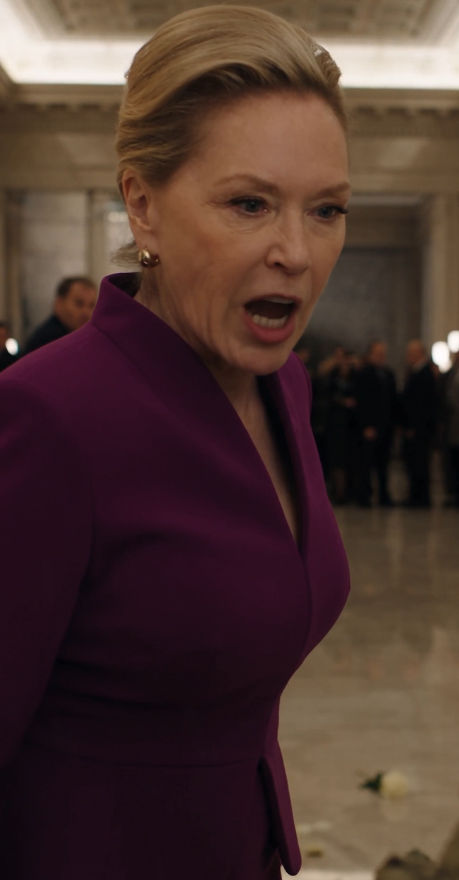
“Don’t touch my dress!” I snapped at the little girl standing in front of two hundred of Charleston’s wealthiest people. She couldn’t have been older than nine, and her muddy fingers were inches from my expensive ivory gown. But instead of running away, she opened her hand and showed me half of a broken silver moon. Then she said six words that made my heart nearly stop: “My mom has the other half.”
I had seen that silver moon before. In fact, I had worn its matching half around my neck for nearly thirty years, hidden beneath my clothes where nobody could see it. My fingers moved to my necklace before I could stop them. When I brought the two pieces together, the broken edges fitted perfectly.
My name is Victoria Hale, and I was forty-six years old when this happened. I lived in a beautiful Charleston mansion, had been married to my husband Richard for twenty-two years, and chaired a charitable foundation bearing my family’s name. That afternoon, our annual garden reception was supposed to be flawless. Instead, a little girl in worn sneakers was about to destroy everything I believed about my family.
I knelt in front of her, forgetting the guests who were staring at us. “Sweetheart, where did you get this necklace?” I asked. She looked frightened but didn’t pull away. “My mommy gave it to me,” she answered.
I asked her name, and she said it was Lucy. Then I asked the question I was almost too afraid to speak. “What’s your mother’s name?” The girl looked directly into my eyes and whispered, “Anna Mercer.”
For a moment, I couldn’t breathe. Anna was my older sister, and she had been dead for twenty-eight years. At least, that was what my parents had told me when I was seventeen. But the name Mercer made the impossible suddenly feel terrifyingly real.
Daniel Mercer had been the groundskeeper’s son on my father’s estate. Anna had fallen in love with him when she was nineteen, and my father had made it clear that Daniel would never be welcome in our family. I remembered hearing terrible arguments behind Father’s study door. Then, almost overnight, Anna disappeared from my life.
Mother told me Anna had been sent away because she was emotionally troubled. Two weeks later, my parents announced that she had died in an accident. They said the circumstances were too painful for me to see her body or attend a funeral. Whenever I asked questions, Father became furious, and eventually I stopped asking because I couldn’t bear another argument.
But I had never stopped missing her. I wore my half of the silver moon through college, through my wedding, and through every birthday when I wondered what Anna would have looked like if she’d lived. The necklace had been our father’s gift after we fought over the same pendant as children. There had only ever been two halves.
Now one of those halves was resting in a stranger’s muddy palm. I took Lucy’s hand and asked where her mother was. “St. Catherine’s Hospital,” she whispered. When I asked why Anna hadn’t come herself, the little girl’s eyes filled with tears.
“She’s really sick,” Lucy said. “And she didn’t know if you’d want to see her.” I felt something break inside me when she said that. Why would my sister believe I didn’t want to see her, when I had spent twenty-eight years wishing she were alive?
My husband Richard approached when he noticed the crowd gathering around us. He asked what was happening, and I told him the little girl claimed to be Anna Mercer’s daughter. Richard looked confused and asked, “Who’s Anna?” After twenty-two years of marriage, I had never told him I once had a sister.
“My sister,” I whispered. “The one my parents told me was dead.” Richard stared at me for several seconds, then quietly took my champagne glass and placed it on a nearby table. “Then we need to go to that hospital,” he said.
During the drive, Lucy sat in the back seat clutching her necklace. She told us that her mother had worked in hotel laundries, restaurants, and cleaning jobs, and that they had moved several times. Her father, Daniel, had died five years earlier. I listened in silence, struggling to understand how my supposedly dead sister could have been living a difficult life while I attended charity receptions in her hometown.
I wanted to ask a hundred questions, but Lucy looked exhausted. Instead, I asked whether her mother had ever spoken about me. Lucy nodded and said Anna sometimes cried while looking at an old photograph. Then she told me something that made the journey feel unbearably long.
“Mommy said you used to be best friends,” she whispered. “But she said something happened, and you didn’t want her anymore.” I turned toward the window because I couldn’t let that child see what those words did to me. I had never stopped wanting my sister.
At St. Catherine’s, Lucy led us to Room 417. Richard stayed behind as I approached the door, and I heard a weak woman’s voice asking whether Lucy had returned. My knees almost gave way because I recognized that voice immediately. It was older and weaker, but I knew it as surely as I knew my own name.
I pushed open the door and saw a thin, gray-haired woman lying beneath white hospital blankets. Her face was hollow, and she looked terribly sick, but her eyes were exactly as I remembered them. Lucy hurried to the bedside and said, “Mommy, I found her.” The woman looked at me and smiled.
“Hello, Vic.”
Only one person had ever called me that. I crossed the room and slapped her before I could think, then immediately began sobbing because the woman in front of me was real. Anna caught my wrist gently and whispered, “I thought you knew.” I stared at her, unable to understand what she meant.
“My parents told me you died,” I said. Anna’s face went completely white, and her fingers tightened around mine. She looked as though I had just told her something more terrible than her own illness. Then she whispered, “Victoria, they told me you never wanted to see me again.”
Anna’s fingers slipped against mine, and the heart monitor gave a sharp, indignant beep. I looked from her pale face to the strip of silver moon lying between our hands.
“No,” I said. My voice sounded like it belonged to someone standing across the room. “I wrote to you. Every birthday for years. I left letters on your old bedroom windowsill because I didn’t know where else to put them.”
Anna closed her eyes. “I wrote, too.”
“Who told you I hated you?”
She opened them again and looked past me toward Lucy, who stood clutching the hem of Richard’s jacket. “Mother,” she whispered. “Father said you were ashamed of me. Mother brought me a letter she said you’d written. It said I was never to come home.”
My knees weakened, and Richard pulled a chair beside the bed before I could fall. Outside the narrow window, a helicopter moved toward the hospital roof, its blades making a faint pulsing sound through the glass. The ordinary world went on while twenty-eight years rearranged themselves in my mind.
“I didn’t write that letter,” I said. “I didn’t even know you were alive.”
Anna covered her mouth. Her shoulders shook, but she made no sound. Lucy came close and touched her mother’s arm. I wanted to gather both of them into my arms, but the girl was watching me with the caution of someone who had already witnessed me raise my hand against her sick mother.
I looked at Lucy first. “I am sorry I shouted at you about my dress,” I said. “And I am sorry I hit your mother. Neither was your fault. I was frightened and angry, and I behaved badly.”
