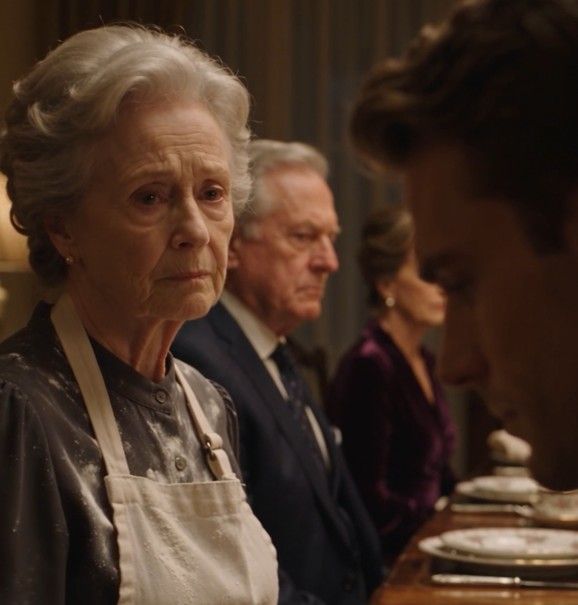
“We didn’t exactly plan for this to be your event, Beverly,” Sasha said, straightening a napkin at the head of my dining table.
The turkey I had been roasting since dawn was still in the oven. My late husband’s carefully collected china covered the table, and Sasha’s friends lowered their eyes to their wine. My son Trevor stood beside them, unable to meet my gaze.
Sasha suggested I might be more comfortable upstairs.
I was still wearing the apron I had tied at 4:30 that morning, in the kitchen I had owned for thirty-one years. For a moment, I felt the old sting. Then something in me settled. It wasn’t heartbreak anymore. It was clarity.
This was not the first time she had tried to erase me from my own home. It was simply the first time she had done it in front of witnesses.
Fourteen months earlier, Trevor had called from a parking lot. He and Sasha needed a place to stay, he said, just three or four months, until they were stable again. He sounded like the little boy who used to crawl into my bed during thunderstorms. Gerald had been gone six years by then, taken by pancreatic cancer in four months. This house still held his gardening gloves by the back door, his chair at the table, and the stair he always avoided.
I gave them the largest guest room, fresh towels, and flowers. I wanted them to feel safe. At first, Sasha thanked me. Then she began changing the house. Gerald’s pillows disappeared. A watercolor painted by my friend after his funeral was replaced with something gray and angular. When I asked Trevor to put it back, he stared at the floor and said, “She’s just trying to make it feel like home.”
The blue ceramic mug Trevor made me when he was twelve vanished from the front cupboard. Sasha said the matching white mugs were more practical. I told her my son’s mug stayed where I could reach it. Her smile said, For now.
By summer, she held client calls at my dining table. By fall, her mail arrived addressed to “The Palmer Residence,” though my name was Beverly Whitaker. She corrected my grocery lists, rearranged my laundry schedule, and moved family photographs upstairs because the living room should feel “neutral.” Each time, Trevor offered the same excuse: “She means well, Mom.”
So I stayed quiet until Christmas morning. I woke before dawn, as I always had with Gerald, and cooked alone. When Sasha told me I didn’t belong at my own table, I finally understood: she wasn’t helping or redecorating. She was replacing me.
I had kept records of every letter, every dismissal, every boundary she had quietly erased. Now, with her friends watching and Trevor still silent, I reached for the folder I had placed beside my chair.
Sasha’s smile faltered as I opened it. I was about to show her exactly whose house this really was.
I turned the first page toward Sasha. It was a printed copy of the deed, followed by the property tax statement, the insurance renewal, and a page showing the date Gerald and I had bought the house. My name appeared on each document. Gerald’s name had been removed from the deed years earlier, after his death. No one else’s name had ever been added.
“This is my home,” I said. “I invited you to stay for three or four months. It has been fourteen.”
Sasha’s friends shifted in their chairs. One of them set down her glass. Trevor finally looked at the papers.
“I didn’t know you kept all this,” Sasha said.
“I keep records of what matters.”
“You’re making this a legal issue?”
“I’m making it clear. You cannot tell me to leave a house I own.”
The turkey timer went off in the kitchen. No one moved. I heard the oven click, then the faint rattle of the baking pan. The smell of rosemary and browned skin filled the room, almost absurdly warm against the cold faces around the table.
Trevor stepped forward. “Mom, this isn’t how we should talk about it.”
“Then how should we talk about it?”
He looked at the folder. “Not in front of guests.”
“You and Sasha chose to tell me to go upstairs in front of them.”
Sasha’s cheeks colored. “I didn’t say you had to leave the house. I said you might be more comfortable upstairs while we had dinner.”
“At my table, in my home, after I cooked the meal?”
“It was supposed to be a dinner with my friends.”
“Then you should have planned it somewhere else.”
Trevor rubbed his forehead. “I’m sorry.”
I wanted to accept the words. But they came after I opened the folder, not when his wife told me I didn’t belong. “You should have said that before I had to prove the deed was mine.”
