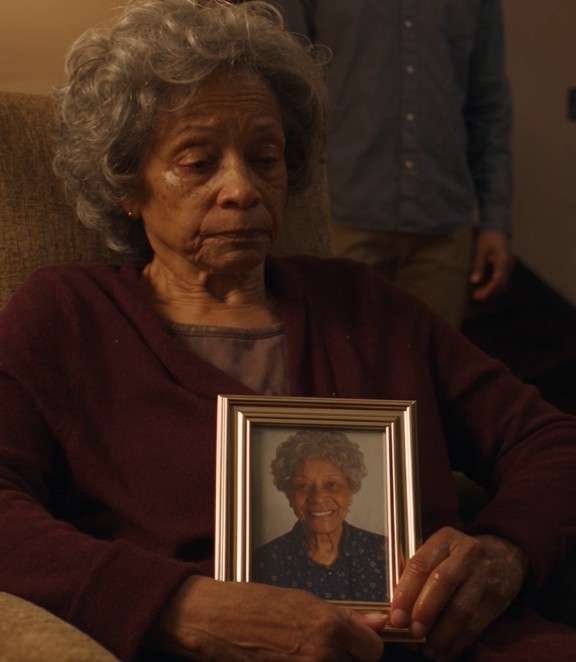
Susan snatched Frank’s photograph out of Betty Walsh’s hands before the seventy-eight-year-old could pull it back to her chest.
“Get upstairs, Betty. My parents need your bedroom.”
For a moment, Betty stared at the empty space in her hands. Susan stood over her, holding the photograph as though it were something to throw away.
“You don’t belong down here.”
Betty had survived Jim Crow and widowhood. She knew what it felt like to lose someone, and what it felt like to be told she had no place. But hearing those words in her own home made her turn to the one person she thought might stop them.
Jake was right there.
Her son had heard every word. He had seen Susan take Frank’s picture. Betty waited for him to say something—anything—but he kept his mouth shut.
His silence hurt worse than Susan’s command.
Susan looked at the photograph and held it out toward Betty.
“Take this junk, too.”
Betty reached for it slowly, careful of its edges even though her fingers were shaking. Susan might call it junk. Betty could not bear to let it fall.
“I’ll go,” Betty whispered.
Susan smiled.
Betty saw that smile as she took back Frank’s picture. Susan had got what she wanted: Betty had agreed to leave the room, and Jake had done nothing to make her stay.
He still would not meet his mother’s eyes.
Once, when Jake had needed shelter, Betty had given him hers. Now she was being ordered upstairs so Susan’s parents could have her bedroom, while the son she had helped stood by.
Betty held Frank’s photograph close. Her fingers tightened around the frame, but when she spoke again, her voice was steadier.
“When you needed shelter, I gave you mine,” she told Jake.
Susan’s smile had been for Betty. Betty’s next words were for her son alone.
“Did you tell her I’m the only name on the deed?”
The question changed the room.
Susan had just told Betty she did not belong downstairs. Yet Betty was the only name on the deed. She did not ask Susan whether she knew that. She asked Jake whether he had told her.
Across the room, Susan’s father went pale.
He looked at Jake, then seemed to think back to the papers they had signed. Betty watched his expression change. He had been quiet until then, but now he needed an answer from Jake, too.
“Jake,” he said, “whose signature is on the papers we signed?”
Betty kept Frank’s photograph in her hands. Susan was no longer smiling. And Jake, who had stayed silent through everything his mother had endured, was the only one who could answer his father-in-law’s question.
Whose signature was on those papers?
Jake’s mouth opened, but no sound came out.
The old wall clock ticked above him. Once. Twice. On the third stroke, the photograph slipped in Betty’s hands, and the glass gave a tiny, brittle rattle.
Susan’s father stepped closer. His name was Harold, and the color had drained from his face so completely that the veins at his temples stood out like blue threads.
“Answer me,” Harold said.
Jake looked at Betty first.
That was the first thing he had done all evening that belonged to her.
His eyes were wet, but the tears had not yet fallen. He looked younger than his forty-six years, almost like the boy who had once stood in the rain with a cardboard suitcase pressed against his chest. Betty remembered that boy. She remembered opening the door at midnight, pulling him inside, and wrapping him in Frank’s old work coat because Jake had been shaking too hard to speak.
Now he stood in the same house wearing an expensive gray jacket Susan had chosen for him, with his hands hanging uselessly at his sides.
“Jake,” Susan said sharply.
He flinched.
Harold turned toward his daughter. “You told me this house was being transferred.”
“It is,” Susan replied. Her voice was too quick. “There’s paperwork. Jake handled it.”
“Jake handled it,” Harold repeated. “You said Betty agreed.”
