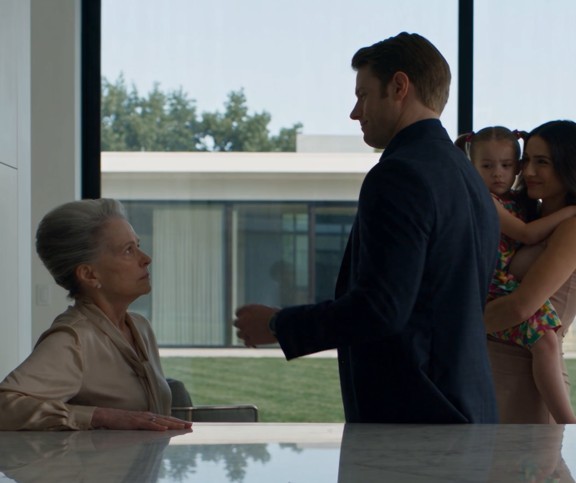
Preston dropped his keys onto the marble and pointed me toward the guesthouse.
“Kendra gets the main house,” my son said. “You get the guesthouse.”
For a moment, I stared at the keys. He spoke as though the decision had already been made, as though all I had left to do was move.
“You’re not taking my villa, Preston.”
Kendra stood beside him with my granddaughter on her hip. Neither of them looked surprised by what he had said. My granddaughter shifted against Kendra’s shoulder while I waited for Preston to tell me I had misunderstood.
He didn’t.
I looked from my son to the home around us. He knew what this place meant to me. He also knew exactly where the money had come from.
After my divorce, Preston had called the apartment behind the laundromat my “reality check.” I had lived with those words for years. Now he was offering me a guesthouse and expecting me to be grateful.
“You said that apartment behind the laundromat was my reality check,” I told him.
“And now you can afford to help.”
He said it so plainly that I almost missed the accusation beneath it. Help whom? Kendra, who was standing ready to take the main house? Preston, who was assigning rooms in a home he hadn’t bought?
My hand closed around his keys. I snatched them off the marble before he could reach for them, and the metal pressed hard into my palm.
“Grandmother’s properties bought this home. Not you.”
Preston watched me hold the keys. I had expected him to argue about money, or tell me again that I owed him something. Instead, he went quiet.
That was when I noticed Kendra watching him, too.
She shifted my granddaughter onto her hip and said, “Show her, Preston.”
My grip tightened. Show me what?
For one brief second, I thought he might have brought an eviction notice from their landlord. Something to explain why they needed my house badly enough to push me out of it.
Preston reached for a folded paper.
I kept the keys in my hand while he opened it. I wanted to tell him that no piece of paper could change who had paid for this villa. Then I saw the words at the top.
Death certificate.
I read the name beneath them. Then I read it again.
It was mine.
The room seemed to go still. Kendra was holding my granddaughter. Preston was standing in front of me. And in his hands was a document saying I was dead.
I looked up at my son. He did not try to take it back.
“The inheritance was easier without you, Mom.”
The keys dug into my palm as I stared at him. Grandmother’s properties. This house. The certificate with my name on it.
If they had made me dead on paper, there was one thing I needed to know.
“Then who’s buried under my name?”
The question did not echo. It seemed to fall straight down between us and disappear into the marble floor.
My granddaughter began to cry.
It was a small, uncertain sound at first, the kind a child made when the adults around her became dangerous without raising their voices. Kendra held her closer and glanced toward the hallway. Preston folded the certificate with careful hands.
“Don’t make this uglier than it has to be,” he said.
“Uglier than a grave with my name on it?”
“You were going to lose everything anyway.”
“Was I?”
His jaw moved. Behind him, sunlight poured through the tall windows and struck the glass cabinet where I kept Grandmother’s silver. The reflections trembled across the walls as though the house itself had begun to shake.
I took out my phone.
Preston stepped toward me. “Who are you calling?”
“The police.”
Kendra inhaled sharply. My granddaughter buried her face against her shoulder.
Preston’s expression changed then. Not fear. Calculation. The same expression he had worn as a boy whenever he had broken something and was deciding whether to confess or blame the dog.
“You don’t understand what you’re doing,” he said.
“I understand that someone forged my death certificate.”
“And if you call them, you’ll be arrested.”
“For what?”
He looked at the paper in his hand.
“Identity fraud. Insurance fraud. Tax evasion. The estate was transferred under your name. Your signature is on everything.”
For a moment, the room narrowed to the sound of my own breathing.
“My signature?”
Kendra looked at him. “You said it was handled.”
“It is handled.”
“No,” I said. “It is not.”
I pressed the emergency number, but before the call connected, the front door opened.
A woman stepped inside wearing a dark blue coat beaded with rain. She carried a leather folder against her chest and stopped when she saw me.
Her face went pale.
“Evelyn?”
I had not heard my name spoken with relief in years.
The woman behind her was older, silver-haired, and rigid with anger. I recognized her immediately. Margaret Vale had been Grandmother’s attorney. She had handled every deed, every trust, every dispute after Grandmother died.
Margaret looked at Preston first, then Kendra, then the certificate in his hand.
