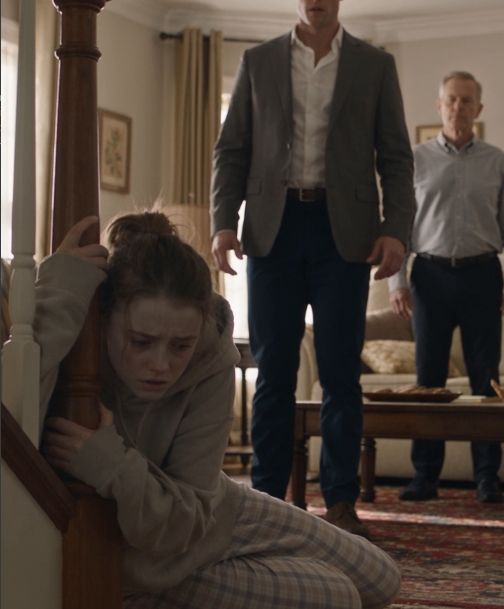
Theodore Ashford’s hand did not leave her arm.
He held on through the silence — the long, ringing kind — while her grandmother’s enormous glasses finished their slow skid across the hardwood and came to rest against the sideboard, while her father made a small wounded sound somewhere behind her.
Clare could feel his pulse through his fingers. Steady. Unhurried. As if the room were not on fire.
She pulled her arm back. “You’ve got cream on your sleeve.”
He looked down. A pale white stripe had transferred from her wrist to the charcoal wool of his cuff. “I’ve got worse on worse,” he said, and crouched and gathered up the runaway flip-flop and the huge 1980s glasses, and stood there holding both of them like objects he had traveled a very long way to return.
“Clare,” her father said, with the exhausted authority of a man losing an argument he hadn’t known he was in. “Go and change. Put on something—”
“Appropriate?” Her own voice came out pleasant, which frightened her more than shouting would have. “No.”
Theo’s mouth twitched — not quite a smile, the ghost of one — and then it was gone. He held the flip-flop out to her. She took it, and their fingers overlapped on the rubber for a second longer than the exchange required, and she became suddenly, painfully aware of every square inch of her own body.
“Kitchen,” he said. Not a question. He took her elbow again, steered her past her father’s open mouth, through the swing door, and kicked it shut behind them.
The fridge hummed. Late afternoon light came through the window over the sink in one long dusty bar, and in the black glass of the oven door Clare could see her own reflection: the bird’s nest, the white socks, the crooked glasses, the cold cream catching the light. She looked like a person who had lost a fight with a department store.
“Stop it,” Theo said.
“Stop what.”
“Standing three feet away from me like a sentencing.” He set the flip-flop on the counter between them and squared it to the edge with both hands, an absurdly careful gesture. “Nine years, Clare. You can look at me.”
She looked. Harder than she meant to. The jaw was different, the shoulders were different, but the eyes had not changed at all — still that particular blue, still faintly amused, still the exact pair she had failed to forget through two cities, three jobs and one extremely humiliating haircut.
“You were supposed to run away,” she said.
“Most men would have.”
“Most men aren’t—” She stopped the sentence with her teeth. Too late. He had already heard it, because something shifted behind his face, a door opening half an inch and then holding there.
“Why are you really here?” she asked. “And don’t say my father invited you. My father has invited twenty-six rich single men this year and I scared every one of them off.”
“Twenty-six.”
“I keep a list. It lives next to the hole in the wall where I threw my self-respect.”
He laughed — short, involuntary, startled out of him — and the sound did something idiotic to her breathing.
“Your father asked me to come because he wants to sell Montgomery Construction and he has run out of buyers who don’t know what he owes,” Theo said. “Ashford Capital could buy it. I said I’d come.”
“That’s not an answer, Theodore.”
“No.” His hand went to his breast pocket and pressed flat against it, quick, a reflex — and she saw the pale corner of folded paper at the opening, worn soft at the crease, a corner gone almost translucent with handling, before his palm covered it. “It’s the half I’m allowed to give you before your father gives you the rest.”
The kitchen door swung. Edward stood in it with his tie yanked loose and his cuffs unpaid, aged ten years since that morning. “Theodore,” he said, “you’d better know what you’re offering to buy before you offer me a dime.”
Edward talked the way people pull off a bandage. Badly, and all at once.
Three years ago the crews had gone unpaid for two months. A private lender named Alistair Crane had stepped in — fifty-four, cedar cologne, a watch that cost more than the truck fleet — and the first note had been easy. The second note was easier. By last spring the interest had eaten the company, and Edward had been signing papers he did not read in an office that smelled of leather and something older than leather.
“And the signatures,” Theo said quietly. He had gone very still. “On the transfer. On the deed. Yours?”
Edward’s mouth opened and closed. Clare watched her father’s hands fail to find anywhere useful to go.
“Say it,” she said.
